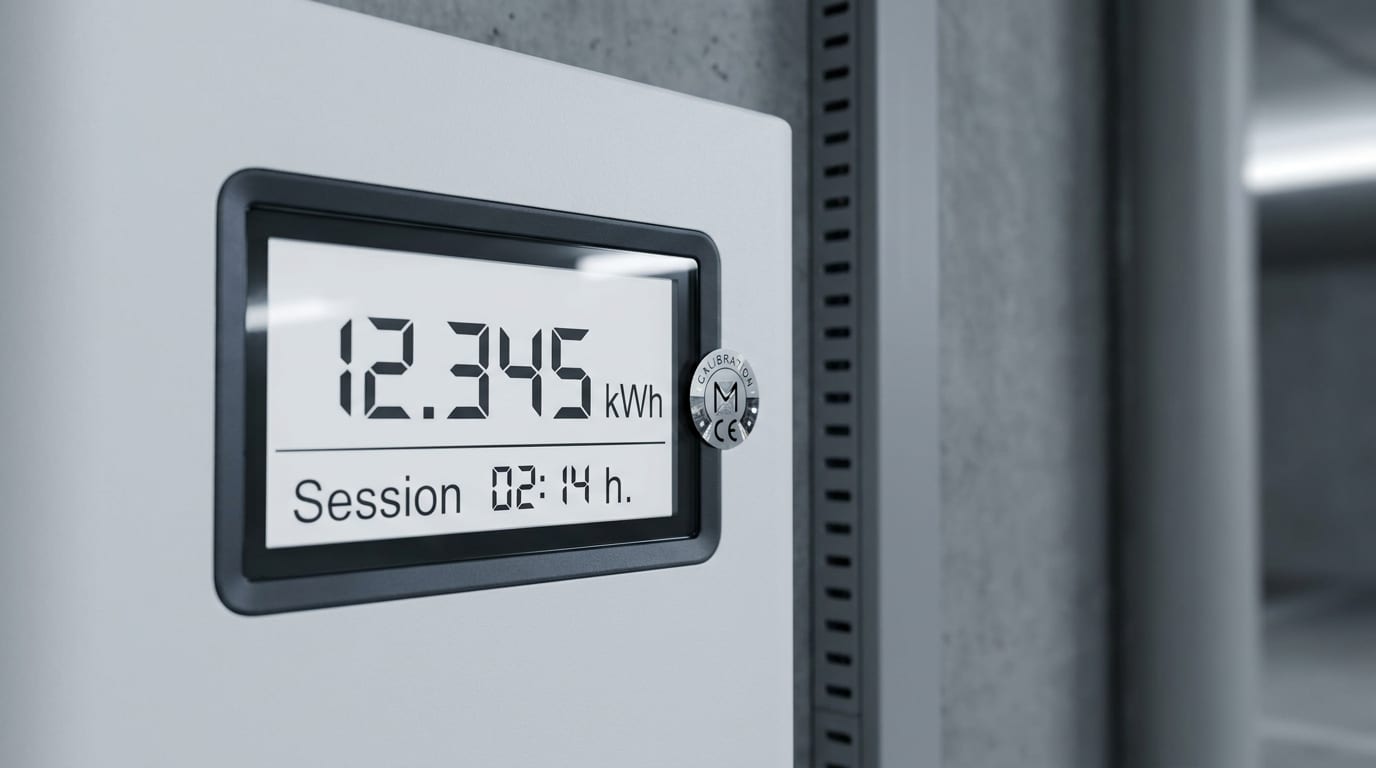
Short answer: In Germany, a calibration-law-compliant wallbox is required in 2026 whenever electricity is transferred for value to a third party — so for employer reimbursement of company-car charging, multi-unit residential buildings with per-resident billing, underground garages with rotating users, vacation rentals charging guests, or any semi-public setting. MID certification of the meter alone is not enough — what’s required is the entire data chain: signed measurements, protected transmission, and an auditable receipt. Calibration-law-compliant wallboxes are PTB-listed; other models are, depending on the use case, simply not legal to bill from.
What does “calibration-law-compliant” actually mean?
Germany’s Measurement and Calibration Act (Mess- und Eichgesetz, MessEG) prescribes how electricity must be measured when it is sold to third parties. The goal: the buyer of the electricity — driver, tenant, employee, guest — must be able to verify and audit the quantity they are being charged for.
Three pillars carry the system:
- Measurement. The installed kWh meter must be certified (PTB type-approval) and periodically calibrated. The display must be visible to the driver.
- Data protection. Each measurement is digitally signed with a private key. The public key is displayed at the wallbox or in the backend — so the buyer can verify, if challenged, that the measurement was not tampered with.
- Tariff structure. Billing is strictly per kWh. Time-based tariffs or flat session fees are not allowed in the calibration-law domain. Parking or service fees are permitted but must be itemised separately on the invoice.
A calibration-law-compliant wallbox meets all three requirements out of the box — and is listed as an approved model at the Physikalisch-Technische Bundesanstalt (PTB).
When is a calibration-law-compliant wallbox mandatory?
The trigger isn’t “electricity sold” but “transfer for value”. Four typical cases:
1. Company-car reimbursement by the employer
Anyone charging an electric company car at home and being reimbursed by the employer is subject to calibration law — as soon as the reimbursement is per kWh. A flat-rate BMF allowance without measurement isn’t subject, but is financially unattractive at higher mileage. Details: Company car home charging 2026 and Calibration-law-compliant wallbox for company cars — why MID isn’t enough.
2. Multi-unit buildings / HOAs with individual billing
As soon as multiple users in an HOA or rental property share charging infrastructure and electricity is billed per user, calibration law applies. Wallbox models must be certified accordingly. More in our funding guide for charging in multi-unit buildings 2026.
3. Rentals with a separate charging tariff
If the landlord bills charging electricity separately from household electricity, that is a calibration-law-relevant transfer. Same conclusion: compliant wallbox or legal exposure.
4. Vacation rentals / semi-public (hotels, restaurants, commercial)
As soon as guests or customers pay for their charging, calibration law is mandatory. A vacation rental adding a charging surcharge to the nightly rate falls under it. More: Wallbox for vacation rentals — automatic guest billing.
Not subject to calibration law: purely private use (one person, one car, one household) and flat-rate reimbursements without measurement (see BMF allowances).
Calibration law vs. MID — the key point
The most common confusion: “I have an MID-certified wallbox, so I’m calibration-law-compliant.” This is wrong.
- MID (Measuring Instruments Directive, EU 2014/32/EU) certifies the meter’s measurement accuracy. It says: “This meter measures kWh correctly.”
- Calibration law (Germany’s MessEG) certifies the entire data chain from meter to receipt. It says: “This measurement is not only correct, but also auditable, signed, and tamper-evident.”
An MID-only wallbox produces correct kWh values — but cannot sign them or deliver them via a protected data chain as an audit-grade receipt to the buyer. In practice this means: in a dispute with the tax authority, the employee, or the tenant, you cannot prove that the billed kWh were actually consumed. More detail: Calibration-law-compliant wallbox for company cars — why MID is not enough.
Practical consequence: Anyone buying a wallbox to sell electricity must explicitly ask for a PTB-listed, calibration-law-compliant model — not for “MID certified”.
Calibration-law-compliant wallbox models on the German market
Several manufacturers offer PTB-certified, calibration-law-compliant models in 2026 — including Easee, Mennekes, ABL, Webasto, Hesotec, and others. Which model fits a specific use case depends on three questions:
- Where is it installed? In an underground garage without cellular reception, the wallbox must work offline — many certified models require constant cloud connectivity. (This is what we built SecureCharge for: calibration-law compliance without a permanent network connection.)
- Who bills? The wallbox only delivers signed measurement data. Billing to the driver, employee, tenant, or guest happens via a backend/app — which must also be part of the certified data chain.
- How many users? A calibration-law-compliant wallbox for a single user is relatively straightforward. A shared wallbox with rotating users — like an underground garage — additionally needs certified user authentication (RFID, app, etc.) that cleanly attributes each session.
A common mistake: a certified wallbox model is not automatically a certified end-to-end solution. The wallbox + backend + app must appear together in the PTB type approval as a complete system, otherwise the data chain is broken.
Billing and signatures — how the data chain works
A calibration-law-compliant session in concrete terms:
- Authentication. The user identifies themselves at the wallbox (card, app, etc.). The identity is bound to the session.
- Measurement. The certified meter records per kWh and produces signed logging with start and end meter readings.
- Signing. The measurement data is digitally signed with the wallbox’s private key. Tampering would invalidate the signature.
- Transmission. The signed session is transmitted to the backend — in the offline model asynchronously, as soon as connectivity returns (e.g. when the driver leaves the underground garage and the app comes back into range).
- Receipt generation. The backend produces a receipt containing the session, the public key, and a verification hash. The buyer can verify authenticity at any time via a transparency tool (e.g. the S.A.F.E. e.V. Charge Point Validation Tool).
Important: the signature must originate at the point of measurement — not in the backend. Once data is signed, the backend cannot modify it without breaking the signature.
Common mistakes when buying a calibration-law-compliant wallbox
- Assuming “MID = calibration-law compliant”. See above — the most common and most expensive misunderstanding.
- Buying the wallbox, forgetting the backend. Calibration law is a system question, not a component question. Hardware alone isn’t enough.
- Overlooking cloud dependency. Some certified models only work with permanent internet connectivity. A problem in underground garages.
- Not checking funding eligibility. Many funding programs explicitly require calibration-law-compliant hardware — and pay nothing otherwise. Check funding conditions before purchase.
- Wrong model for the use case. A single-user residential wallbox is technically very different from a multi-user underground-garage wallbox. Buying for the wrong case leaves you with a certified but unusable wallbox.
How HeyCharge approaches it
HeyCharge operates a calibration-law-compliant, PTB-listed wallbox platform whose distinguishing feature is offline capability: authentication, measurement, and signing happen at the parking spot — even when there is no cellular, LAN, or WiFi available at the charge point. The signed session data is transmitted asynchronously as soon as the employee or guest app comes back into a reception area.
For three typical setups, HeyCharge delivers the complete solution:
- Company cars at home parking spots — calibration-law compliant with automatic employer reimbursement (Fleet at Home).
- Underground-garage charging in multi-unit buildings and HOAs — calibration-law compliant with per-resident billing (Tiefgarage, Multi-family).
- Vacation rentals with guest billing — calibration-law compliant with automatic per-stay tracking (Vacation rentals).
Unsure whether your planned use case needs a calibration-law-compliant wallbox? Talk to us — the first 20 minutes are free. We’ll review your situation and tell you what the funding conditions and calibration law mean for you concretely.
Read on
- Calibration-law-compliant wallbox for company cars — why MID isn’t enough — the technical depth
- Company car home charging: billing, calibration law, tax 2026 — how this flows through payroll
- Wallbox rollout for employers 2026 — hardware ownership, policy, scaling
- Calibration law technology at HeyCharge — how we build the system in practice
- Apply for 2026 LIS wallbox funding — grants for calibration-law-compliant hardware
Related articles
Eichrecht-Compliant Wallbox for Company Cars — MID Isn't Enough
Why MID certification alone doesn't cover company-car billing: Eichrecht explained, PTB requirements, signed measurement data — what employers must verify.
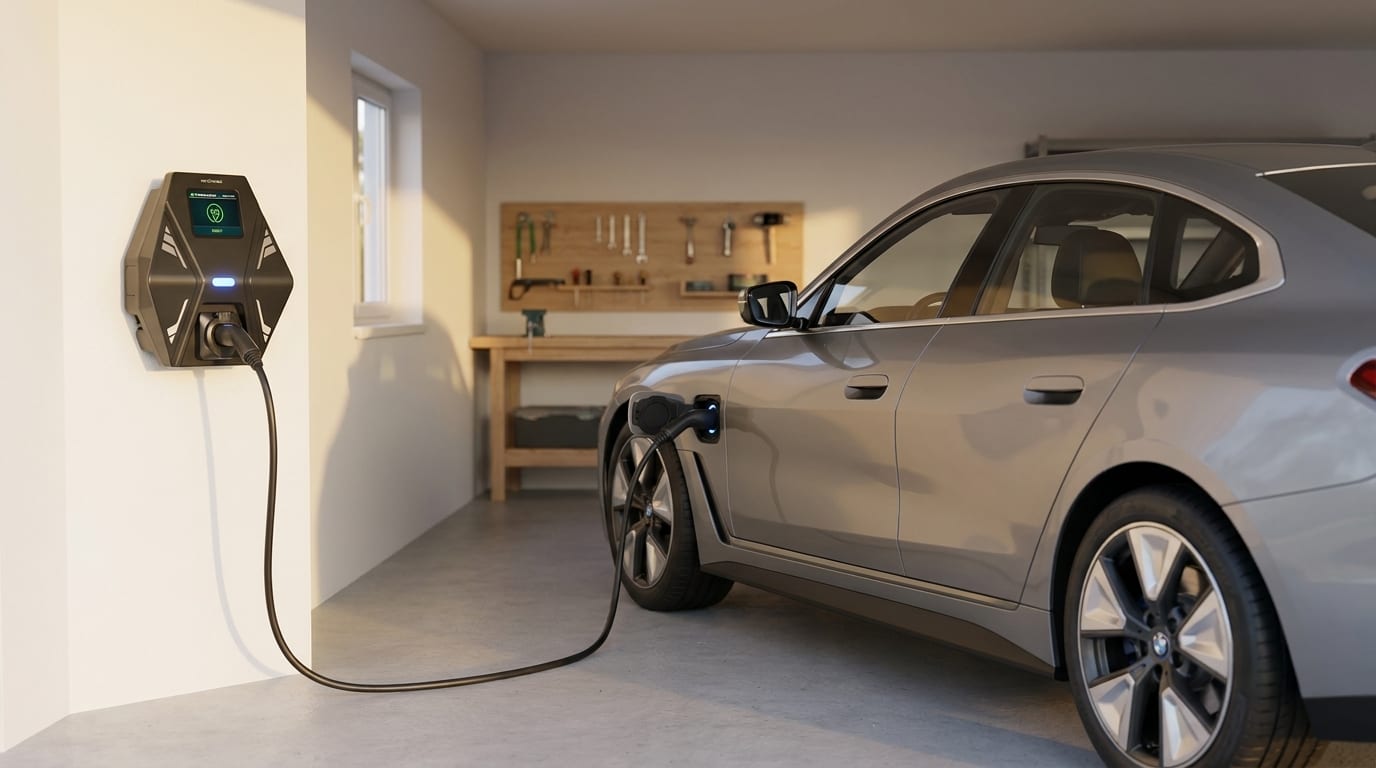
Company-Car Home Charging: Billing, Eichrecht, Tax 2026
How employers reimburse company-car home charging compliantly: §3 No. 46 EStG, Eichrecht requirements, kWh-precise repayment — the 2026 guide.

Wallbox for Company Cars: Employer Rollout 2026
Roll out wallboxes across a company-car fleet: hardware ownership vs. subscription, company-car policy, multi-location scaling — the practical guide.
Ready for charging infrastructure in your building?
Schedule a free consultation — we'll advise you on the best options for your property.
Book a consultation