
Short answer: Anyone driving an electric company car in Germany ends up charging most of the time at the place where the car already sits overnight: at home. For the employer to cover the electricity — and for the employee not to be taxed on it — home charging must be metered cleanly, separated from private consumption, and documented in a way that holds up to a tax audit. Three building blocks matter: a calibration-law compliant wallbox, per-kWh billing via an app, and a written agreement between employer and employee. Funding lowers the hardware cost. If you’re rolling this out for multiple drivers, you also need consistent hardware and policy choices up front.
When does home charging make sense for a company car?
Drivers of electric company cars in Germany typically end up doing 60–80% of their charging at home — if the option exists. Public chargers are more expensive, slower, and unnecessary for most commuter profiles: the company car sits at its parking spot for twelve hours overnight. An 11 kW wallbox can fully charge a typical battery twice in that window.
The economics are clear: home charging costs 28–42 ct/kWh depending on tariff; public AC stations 55–75 ct; DC fast chargers 70 ct to over €1. Over a company car year of 25,000 km, that’s a four- or five-figure difference — money the employer would rather reimburse to the employee’s home parking spot than to a motorway fast charger.
However: the electricity physically flows through the employee’s house connection. Paying a flat monthly reimbursement creates a tax problem (see below) and produces conflicts the moment the employee also uses the car privately. The clean way is per-kWh billing with calibration-law-compliant metering.
Which wallbox do I need for a company car?
Three requirements a company-car wallbox must meet — and that a typical residential wallbox usually doesn’t:
- Separation of private and company-car electricity. The employer pays only the electricity that flowed into the company vehicle — not what the family used through the house connection. The wallbox must be able to attribute the charging session to a specific vehicle or user account.
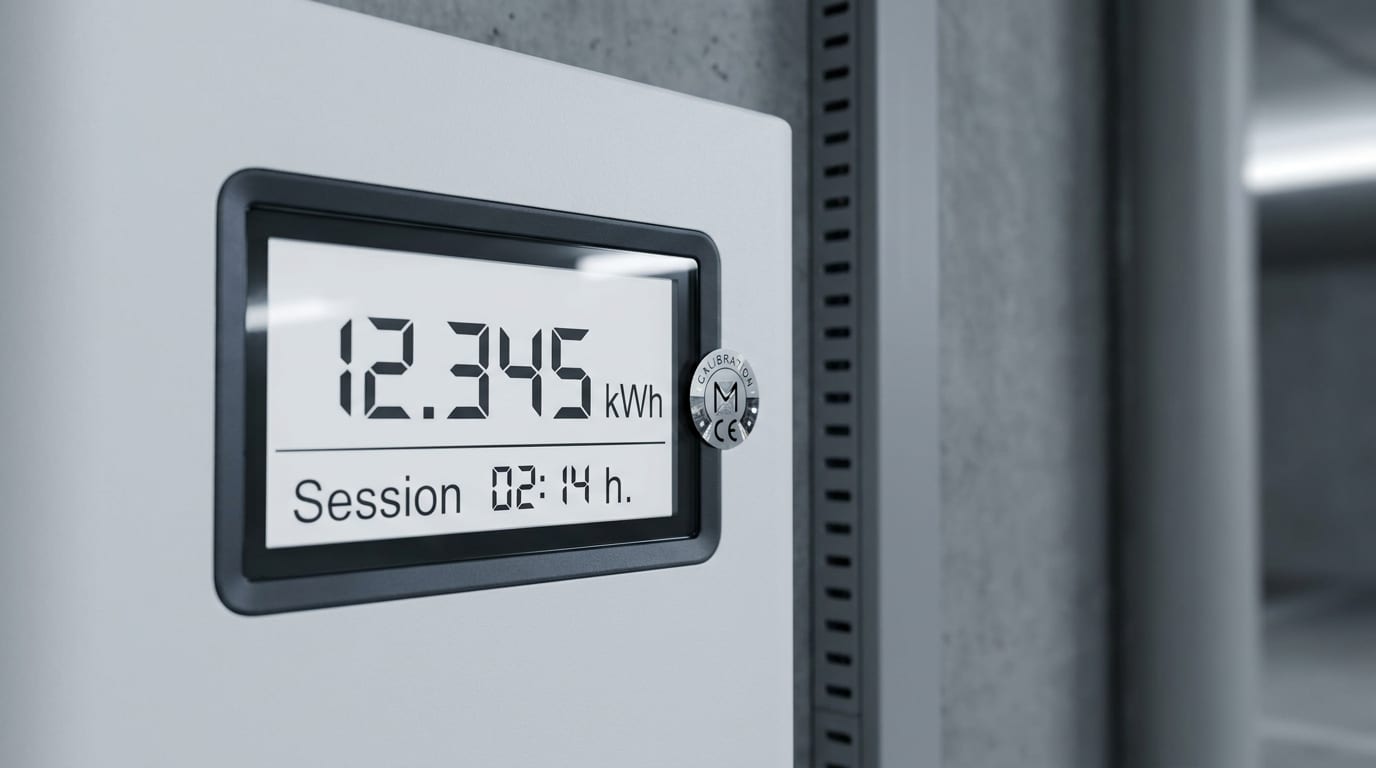
- Calibration-law-compliant metering. MID-certified meters are a necessary but not sufficient condition — we explain this in our guide on MID vs. German calibration law. To reimburse against an employer (and to satisfy a possible tax audit), you need signed measurement data and an auditable data chain.
- Clean receipt generation per session or per month. A spreadsheet is not enough. The employee needs an automatically generated, calibration-law-compliant receipt — ideally directly in the app, with an export to the employer’s payroll system.
A plain 11 kW residential wallbox typically meets only point 1. To be fit for company-car use, the wallbox must be calibration-law compliant and integrated into an app/backend that produces receipts automatically.
Employer reimbursement: §3 No. 46 EStG
Section 3 No. 46 of the German Income Tax Act (EStG) exempts employer-provided charging electricity for electric vehicles from payroll tax — even when the car is charged at the employee’s home. The exemption comes with conditions:
- It has to actually be electricity for a company vehicle. Private consumption by the employee is excluded.
- The reimbursement must be verifiable. Flat rates only work in narrowly defined cases (such as the monthly flat rates the German Ministry of Finance has published for fully electric company cars — those are capped and don’t cover the real consumption of a high-mileage driver).
- Per-kWh proof is the clean route, because it avoids both over- and under-payment and survives a tax audit.
More detail and the exact requirements for the receipt are in our guide to company-car home charging 2026.
Practical consequence: A calibration-law-compliant wallbox plus an app that emails a monthly receipt to payroll is the only solution that holds up in front of the tax authority and the employee in 2026.
2026 funding for the company-car wallbox
Even though the wallbox is installed at the employee’s private parking spot: in many constellations there are 2026 subsidies. Employees living in a multi-unit building may qualify for the federal “Laden im Mehrparteienhaus” program — up to €2,000 per parking space, deadline 10 November 2026. Employees in an HOA with a shared underground garage often charge via shared infrastructure — for which there’s a wallbox grant up to €1,500 per parking space.
A common misunderstanding: the application has to be submitted before the order. Anyone who already bought the wallbox can’t apply retroactively. Before any rollout — even for a single employee — it’s worth checking the funding logic.
Who buys the wallbox: employee or employer?
Three models are common in practice:
- Employee buys, employer reimburses. Simple, but with multiple drivers you get a patchwork of hardware, vendors, and billing logics. If the employee leaves, the wallbox stays with them — and the next driver needs a new one.
- Employer buys, provides to the employee. Consistent hardware, consistent app, a single supplier relationship. Booked as fixed assets or leased. Cleaner for scale — but higher up-front investment.
- Wallbox subscription via a provider. Hardware, installation, service, and software for a monthly fee. No fixed asset, no internal maintenance responsibility, but recurring per-driver costs.
Which model works financially depends on fleet size, expected turnover, and the internal cost of finance/admin. Our practical guide to employer rollouts walks through the decision logic in detail — including the most common pitfalls at 30+ drivers.
Pitfalls we see repeatedly in fleet rollouts
- Wallbox purchased without calibration-law compliance. “MID certified” simply isn’t enough. This catches up with you in the first tax audit — or when an employee’s receipt is rejected for reimbursement.
- No written agreement. Reimburse electricity in writing: what gets reimbursed (per-kWh? capped?), how is it billed (monthly? quarterly?), what happens when an employee leaves, who pays for installation.
- Funding forgotten. Application after purchase = no funding. When in doubt, 30 minutes with a tax advisor or a CPO before the rollout pays off.
- Hardware and app treated separately. A wallbox without an integrated billing app generates as much spreadsheet chaos for the employer as having no wallbox at all. The right answer is a package: hardware + authentication + calibration-law-compliant billing + monthly payroll receipt.
How HeyCharge helps
HeyCharge operates calibration-law-compliant wallboxes that work for single company-car drivers and for fleets of 30 to 300 employees. Patented SecureCharge technology works offline at the parking spot — the employee authenticates via Bluetooth from the app, with no LAN, WiFi, or cellular required at the spot. This is especially important in underground garages, rural regions, and older multi-unit buildings without structured cabling.
The app records each session per kWh, separates company and private electricity, and produces a monthly calibration-law-compliant receipt the employee can forward directly to payroll. Employers with multiple drivers get a consolidated receipt across all employees.
Considering what a company-car rollout could look like in your business? Talk to us — the first 20 minutes are free, and we know the typical rollout pitfalls for fleets between 5 and 300 drivers.
Read on
- Company car home charging: billing, calibration law, tax 2026 — the tax side in detail
- Calibration-law-compliant wallbox 2026 — requirement, selection, models — what calibration compliance actually means technically
- Wallbox for company cars: employer rollout 2026 — ownership models, policy, scaling
- Apply for 2026 LIS wallbox funding — grants for the home wallbox
Related articles

Wallbox for Company Cars: Employer Rollout 2026
Roll out wallboxes across a company-car fleet: hardware ownership vs. subscription, company-car policy, multi-location scaling — the practical guide.
Calibration-Law-Compliant Wallbox 2026 — Rules & Models
Calibration-law-compliant wallbox in Germany 2026: when it's mandatory, how it differs from MID-only wallboxes, which models qualify, and what to check before buying.
Company-Car Home Charging: Billing, Eichrecht, Tax 2026
How employers reimburse company-car home charging compliantly: §3 No. 46 EStG, Eichrecht requirements, kWh-precise repayment — the 2026 guide.
Ready for charging infrastructure in your building?
Schedule a free consultation — we'll advise you on the best options for your property.
Book a consultation