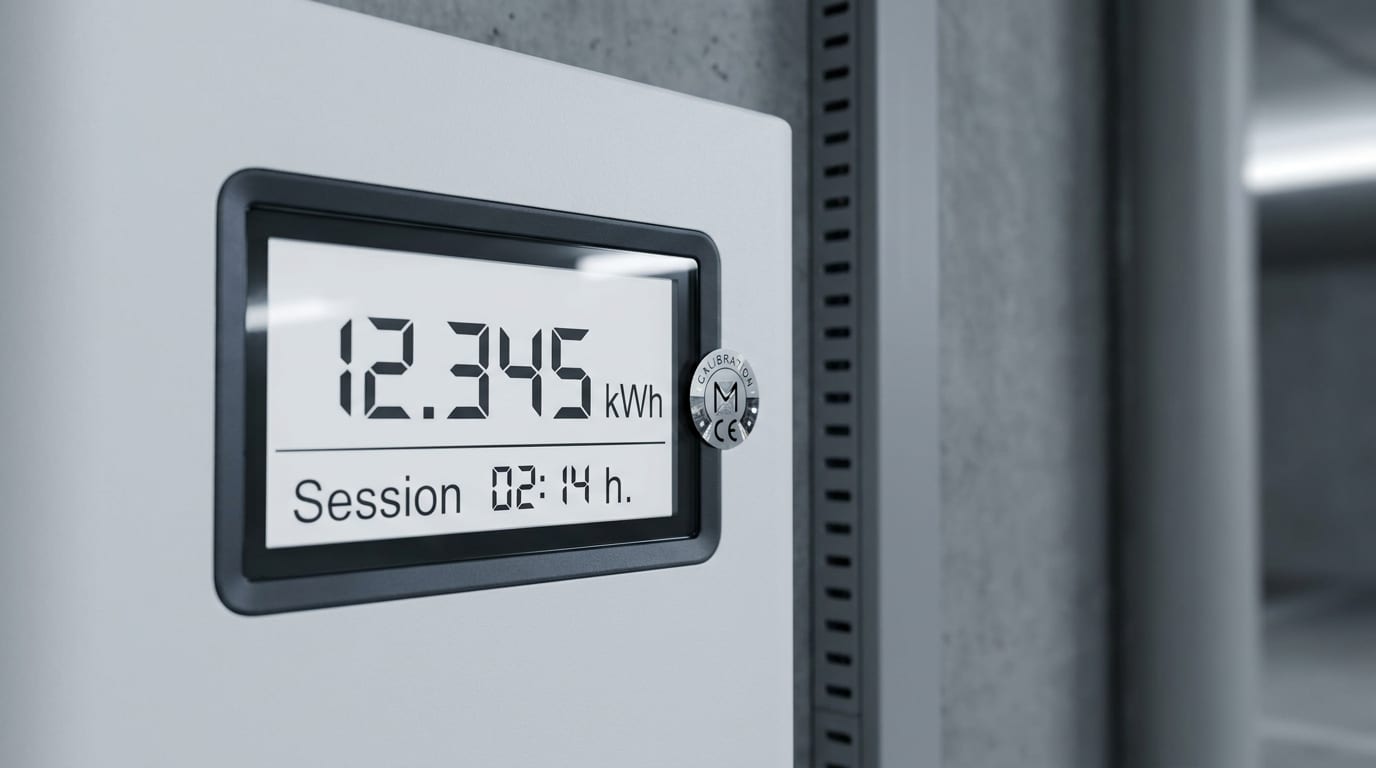
Quick answer: A wallbox with a MID-certified meter is not yet Eichrecht-compliant. MID covers measurement accuracy; Eichrecht covers tamper-proofing and traceability of the entire measurement-and-billing chain. For billing company-car electricity to the employer you need the latter — otherwise the receipts won’t hold up against a German tax-office audit. This guide explains what Eichrecht actually requires in the wallbox context and how employers can spot a compliant box before purchase.
MID, Eichrecht, PTB — what means what?
Three terms that often appear loosely next to each other in wallbox spec sheets:
MID — Measuring Instruments Directive (EU) An EU directive on measurement-instrument accuracy. A MID-certified meter measures kWh in a defined accuracy class (Class B for AC). MID says nothing about whether the result is stored or documented tamper-proof.
Eichrecht — German Metering and Calibration Act Germany’s MessEG and MessEV regulate how measurement must happen when the result is used for commercial billing. Eichrecht builds on MID but goes much further — particularly for wallboxes billing kWh to third parties.
PTB — Physikalisch-Technische Bundesanstalt Germany’s federal authority that tests and certifies under Eichrecht. A PTB type-examination certificate for a wallbox confirms the entire measurement chain is Eichrecht-compliant — not just the meter.
Short version: MID = the meter is accurate. Eichrecht/PTB = the whole wallbox is fit for billing.
What Eichrecht requires beyond MID
For a wallbox that bills electricity in commercial transactions (employee → employer, tenant → landlord, HOA → owner), the PTB checks among other things:
- Signed measurement data. Every charging session is cryptographically signed. Any subsequent modification would be detectable — and invalidate the record.
- On-device display. The wallbox display must show the charged kWh, start/end time, and where applicable an identifier — directly on the device, not only in an app.
- Anonymous storage. Billed data must only be personalizable through additional authentication.
- Backend conformance. The software processing the data (app, backend, billing platform) must also be certified.
- Device-side storage. The signed values are stored in the device itself — not only in cloud backend.
A pure MID-certified wallbox typically covers points 2 and 3 but not 1, 4, and 5.
Why this matters specifically for company cars
For private charging at home with your own wallbox, your own car, and your own electricity, no Eichrecht is needed — nobody is billing anyone.
As soon as electricity is rebilled to a third party Eichrecht applies. With company-car home charging that is always the case — the employee pays via their household bill, the employer reimburses. Concretely under audit that means:
- Payroll-tax audit. The tax office demands proof that the electricity reimbursement actually corresponds to business charging. Without an Eichrecht record the reimbursement is vulnerable as a taxable benefit-in-kind.
- Dispute between employer and employee. With messy quantities there will be discrepancies — employee claims 100 kWh, wallbox shows 80 kWh, employer pays 80, employee is unhappy.
- External auditor review. Larger companies’ auditors require a verifiable chain for payroll-side ancillary costs.
With Eichrecht-compliant hardware all three risks vanish — the chain of evidence is complete and tamper-proof for every session.
What employers should verify before purchase
Before a wallbox for company-car home charging is bought (or subscribed), four checks pay off:
1. PTB type-examination certificate. Ask for the certificate — not just the spec sheet that says “Eichrecht-compliant”. The certificate lists which configuration of the wallbox was tested.
2. Backend certification. The billing software must also be Eichrecht-compliant. Data processing in a non-certified app invalidates the chain.
3. On-device display. Is the kWh quantity readable on the device itself? If only an app shows the value, that’s formally insufficient.
4. Profile / authentication mechanism. Who charged? Multiple users (employee private, employee business, family) must be cleanly separable.
Anyone seeing “MID Class B meter” on the spec sheet and thinking “that’s it” misses the decisive point: Class B accuracy, but no signed data, no PTB check of the entire chain.
HeyCharge Wallbox: Eichrecht from factory
The HeyCharge Wallbox is available in an Eichrecht-compliant configuration — PTB-certified, signed measurement data from factory, backend-certified. For employers that means:
- PTB type-examination certificate is on file and available on request.
- Display on device shows charged kWh after each session.
- Profile separation in the app distinguishes employee-private from employee-business — per session, signed.
- Eichrecht-compliant backend — the billing platform is part of the certification, not a separate external service.
The wallbox ships as both a MID variant (for private use) and an Eichrecht variant (for company cars, multi-family buildings, commercial billing) — the Eichrecht variant is standard in the Fleet at Home subscription.
FAQ
Isn’t a self-written Excel sheet enough for employee reimbursement? For small amounts in isolated cases it’s tolerated. For larger fleets or in audit it’s vulnerable — and the effort of maintaining the spreadsheet quickly exceeds the surcharge for Eichrecht-compliant hardware.
How much more does an Eichrecht-certified wallbox cost? At hardware purchase typically 200–500 € more than the MID variant. In the subscription model the monthly price difference is usually smaller than the annual receipt-management work that disappears.
Do we need this for plug-in hybrids too? Yes. §3 No. 46 EStG applies to PHEVs identically. If the employer reimburses electricity, the same Eichrecht requirements apply — regardless of drivetrain.
Related reading
- Company-car home charging: billing & tax 2026 — Pillar guide
- Wallbox for company cars: employer rollout 2026 — Rollout in practice
- Fleet at Home — overview — the HeyCharge solution
Related articles
Calibration-Law-Compliant Wallbox 2026 — Rules & Models
Calibration-law-compliant wallbox in Germany 2026: when it's mandatory, how it differs from MID-only wallboxes, which models qualify, and what to check before buying.
Company-Car Home Charging: Billing, Eichrecht, Tax 2026
How employers reimburse company-car home charging compliantly: §3 No. 46 EStG, Eichrecht requirements, kWh-precise repayment — the 2026 guide.

Wallbox for Company Cars: Employer Rollout 2026
Roll out wallboxes across a company-car fleet: hardware ownership vs. subscription, company-car policy, multi-location scaling — the practical guide.
Ready for charging infrastructure in your building?
Schedule a free consultation — we'll advise you on the best options for your property.
Book a consultation