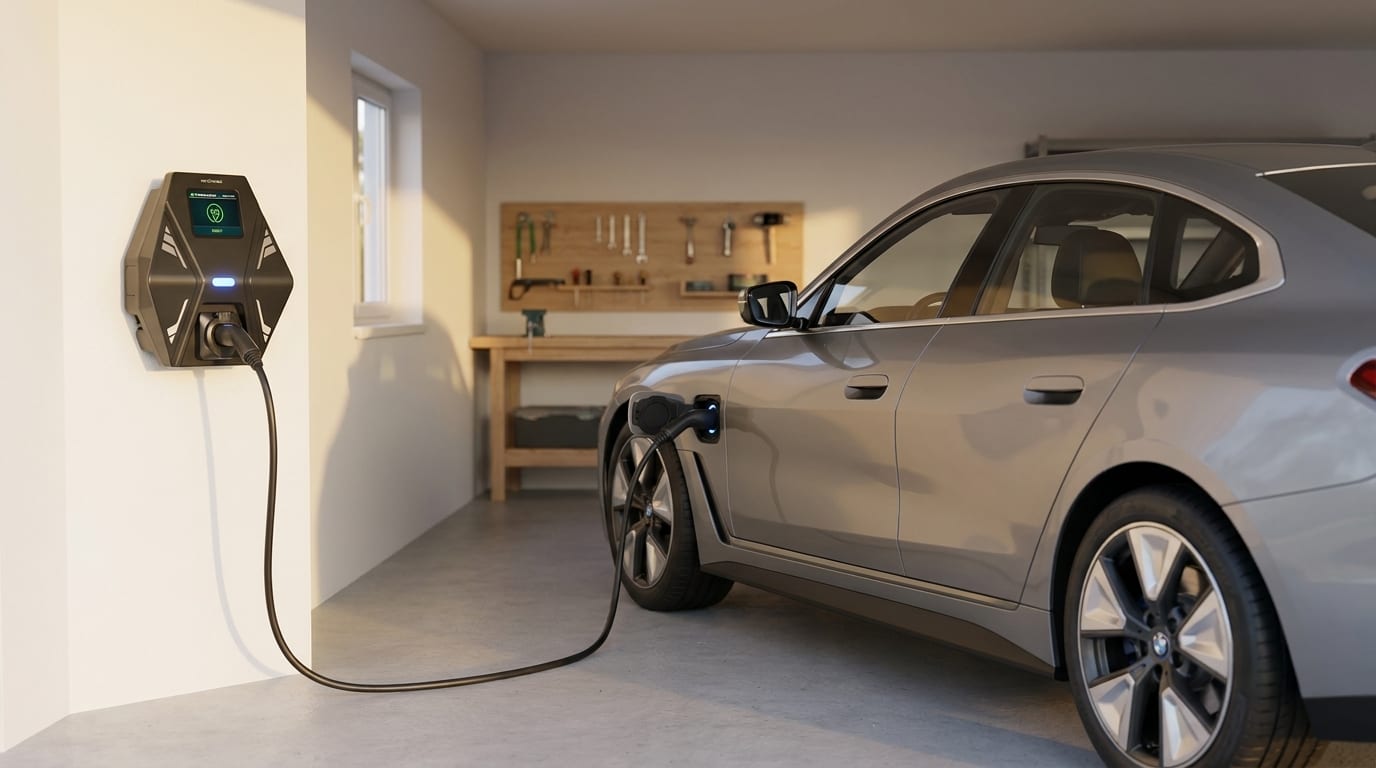
Quick answer: Employees with electric company cars charge mostly at home — and the employer pays for the electricity. For that reimbursement to remain tax-free at the employee level (German §3 No. 46 EStG), home charging must be metered cleanly, private and business consumption must be separated, and the receipt must comply with German metering law (Eichrecht). Flat-rate allowances are convenient but only conditionally accepted; precise kWh-based reimbursement is the clean approach — and only feasible with an Eichrecht-compliant wallbox. This guide shows German employers what actually applies in 2026, where flat rates suffice, where they don’t, and how a fleet-wide rollout works without an Excel disaster.
Why “company-car home charging” is a topic at all
The majority of charging sessions for an electric company car don’t happen at public stations or at the office — they happen in the employee’s own garage or parking spot. Three consequences for the employer:
- The electricity comes from the employee’s home connection. The employer is paying a share of the employee’s private tariff — and has to separate that share cleanly from private consumption.
- There is no central billing. Unlike fueling with a corporate card or charging at the company wallbox, recording sits with the employee — with all the risks for accounting.
- §3 No. 46 EStG only applies under conditions. The German tax exemption for employer-provided charging electricity is well-defined, but has requirements around proof, separation, and tax-deductibility.
In practice many employers solve this with a spreadsheet and a monthly flat rate. That works — until the tax office asks questions or the employee uses the company car privately and the separation gets messy.
When home charging pays off for a company car
Anyone using an electric company car daily charges 60–80% of their volume at home, where the possibility exists. Public chargers are more expensive, slower and unnecessary for most commuting patterns: the vehicle sits at the parking space for twelve hours overnight anyway, and an 11 kW wallbox refills a typical battery in that window.
The economics are clear: home charging costs 28–42 ct/kWh depending on tariff, public AC roughly 50–65 ct, DC fast charging roughly 60–80 ct. Across a company-car year of 25,000 km that is a four-figure difference — money the employer would rather reimburse to the employee’s home parking space than hand to a motorway fast charger.
The catch: the electricity physically flows through the employee’s domestic connection. Paying a flat monthly reimbursement creates a tax problem — and conflict as soon as the vehicle is also used privately.
§3 No. 46 EStG: What employers need to know
The paragraph makes employer-provided or reimbursed charging of an electric company car at the residence tax-free — for both employee and employer. Three conditions are decisive:
- It must be a company car or an employer-provided charging facility. Electricity the employee uses for their own private vehicle does not qualify.
- The energy quantity must be attributable. A flat estimate without proof is tolerated in many cases but legally weak — especially with larger fleets or when the vehicle is also used privately.
- Reimbursements must match actual electricity costs. Flat rates above the verifiable cost count as a taxable benefit-in-kind.
The German Ministry of Finance (BMF) allows monthly flat rates for home charging (letter dated 29.09.2020, continued 2024) — without precise metering, with fixed amounts for pure BEVs and plug-in hybrids. That is the simplest approach but has two catches:
- The flat rates have not changed for years while electricity prices have risen. Employees often pay out of pocket.
- The flat rate only applies if precise metering is not possible. If you have an Eichrecht-compliant wallbox, you must use the actual measurements.
Flat rate vs. kWh-precise reimbursement
| Flat rate (BMF letter) | kWh-precise | |
|---|---|---|
| Effort | Low — fixed monthly amount | Medium — capture per session |
| Fairness | Low — electricity tariff not reflected | High — exact tariff of the employee |
| Tax security | Medium — tolerated case-by-case | High — attributable, documentable |
| Scalability | High <10 drivers, fragile beyond | High with the right wallbox |
| Eichrecht | Not required | Required for billing |
When the difference between employees’ home tariffs becomes relevant (different contracts, photovoltaic systems, off-peak agreements), the flat rate becomes unfair. kWh-precise reimbursement is the clean approach — multiplied by the employee’s real tariff, documented per session.
Eichrecht: When it’s mandatory
In a private context (own car, own wallbox, own electricity) you do not need Eichrecht compliance. As soon as electricity is billed — employee to employer, tenant to landlord, HOA to owner — Eichrecht applies. The requirement: every measured energy quantity must be tamper-proof and traceable.
Concretely for company-car home charging that means:
- PTB-certified meter in the wallbox (not just MID — MID alone is insufficient, details in the Eichrecht guide)
- Signed measurement data per charging session
- Per-user authentication — who charged, with which profile
- Receipt generation the tax office accepts
A typical “smart” wallbox usually does not meet this. The result: the readings are not eligible for billing, the employer pays — but in case of doubt as a taxable benefit-in-kind.
Which wallbox meets the requirements?
Three requirements a company-car wallbox has to meet — and which a purely private wallbox usually does not:
- Separating private and company charging. The employer pays only for electricity that went into the company vehicle, not what the household drew through the same connection. The wallbox must be able to attribute each session to a vehicle or user account.
- Traceable measurement. For reimbursement — and for any tax audit — the energy delivered per session must be provable and attributable to the vehicle. Which requirements apply in your specific case is a question for your tax adviser.
- Automatic receipt generation. A spreadsheet is not enough. The employee needs an automatically generated receipt, ideally in the app, exportable to the employer’s payroll.
A standard 11 kW domestic wallbox typically meets point 1 at best.
Plug-in hybrid company cars: Different, but not different enough
PHEVs are electrified but charge less and in irregular patterns. Tax-wise, §3 No. 46 EStG applies the same. In practice three differences emerge:
- The energy quantities are smaller — the flat rate is relatively more expensive per kWh, which again argues for kWh-precise reimbursement.
- Employees charge less often — some drive their PHEV mostly on petrol. Clean separation prevents “phantom flat rates” for sessions that didn’t happen.
- Wallbox hardware is identical — no extra effort on infrastructure, only on reporting.
For hybrid fleets, kWh-precise capture pays off twice: less dispute, cleaner records, correct tax exemption.
Rollout in five steps
Employers rolling out home charging for the fleet typically follow these five steps:
1. Inventory. How many EV and hybrid company cars, at how many locations, in what living situation? Owners, tenants, multi-family buildings? Underground garage or own garage?
2. Hardware decision. Eichrecht-compliant or not? Owned or subscribed? One box per employee or shared? — In the subscription model the employer provides the box without buying it.
3. Policy. Which employees, which reimbursement method (flat rate or kWh-precise), what private/business separation? What happens on employer change, what on defect? — The policy belongs in the company-car contract.
4. Installation. With one box per employee that means: pre-check (mains connection, breaker, cabling), installation by a certified electrician, commissioning. With a central provider this becomes one process instead of N individual installations.
5. Operation. Charging sessions are captured automatically, the employee sees their sessions in the app, the employer receives a monthly consolidated invoice. For issues there is one support contact for everyone involved — not the employee calling their own building manager.
Funding: check before ordering
Whether a home wallbox for a company car qualifies for funding depends on the specific constellation — ownership, building type and programme — and changes continually. Federal and state programmes are generally aimed at owners and at projects above a minimum size, not at individual tenants.
One rule holds regardless of programme: the application must be filed before ordering. Buy the wallbox first and you cannot claim retroactively. So the funding check belongs before the contract is placed, based on current rules rather than rules of thumb.
Pitfalls we see repeatedly in rollouts
- A wallbox bought without provable measurement. If the unit produces no attributable record per session, it shows up at the first tax audit at the latest — or when an employee drops out of reimbursement because their receipt is not acceptable.
- No written agreement. What gets reimbursed (per kWh? capped?), how often billing happens, what happens on a change of employer or termination, who bears the installation — that belongs in writing.
- Funding forgotten. Application after ordering means no funding.
- Hardware and app treated separately. A wallbox without integrated billing produces exactly as much spreadsheet chaos as no wallbox at all. The answer is one package: hardware, authentication, billing and a monthly statement to payroll.
What HeyCharge Fleet at Home does differently
The HeyCharge approach packages the five steps as one end-to-end product: hardware, software, service, all on a monthly subscription per driver. Three points that make the difference compared with individual wallbox purchases by the employee:
- One consolidated invoice to the employer — not 30 employees with 30 different wallbox receipts.
- PTB-certified meter from factory — Eichrecht is standard, not add-on.
- Profile separation in the app — one wallbox charges both the private and the company car, electricity is automatically attributed correctly.
- Take-back service. When the employee leaves, HeyCharge picks up the box — no investment sitting unused.
- Adapter instead of wallbox when the employee already owns one. If the employee already has an Eichrecht-compliant smart wallbox, the HeyCharge MagicBox handles the fleet layer as a compact retrofit adapter: consolidated invoice, profile separation, automated reimbursement. Eichrecht stays with the wallbox — the adapter adds the software layer but doesn’t replace a calibrated meter. When the employee leaves, only the adapter comes back — no removal of a whole wallbox from a home garage.
More on the solution overview: Fleet at Home for employers.
FAQ
Do we need Eichrecht compliance as employer if we only pay flat rates? If the flat rate follows the BMF letter and no precise measurement happens, Eichrecht is not strictly required. Once measurement is involved, yes — and then the measurement must be Eichrecht-compliant.
Can the employee just buy the wallbox themselves and send us the receipts? Technically yes — fiscally it’s messy. Receipts without Eichrecht compliance are vulnerable; for larger fleets the structured solution via a central platform pays off.
What if the employee has photovoltaic? PV electricity has a different tariff than grid consumption. Strictly correct reimbursement would have to reflect the respective electricity per session — not possible with flat rates, possible with kWh-precise capture.
What does an Eichrecht-compliant wallbox cost monthly? In the subscription model a complete solution (hardware, installation, billing, support) typically starts in the low double-digit euro range per month — depending on fleet size and location. Get a no-commitment quote.
Related reading
- Wallbox for company cars: employer rollout 2026 — Hardware ownership, policy, scaling
- Eichrecht-compliant wallbox for company cars — Why MID alone isn’t enough
- Fleet at Home — overview — The HeyCharge solution at a glance
- Wallbox subsidy WEG 2026 — When employees live in multi-family buildings
Related articles
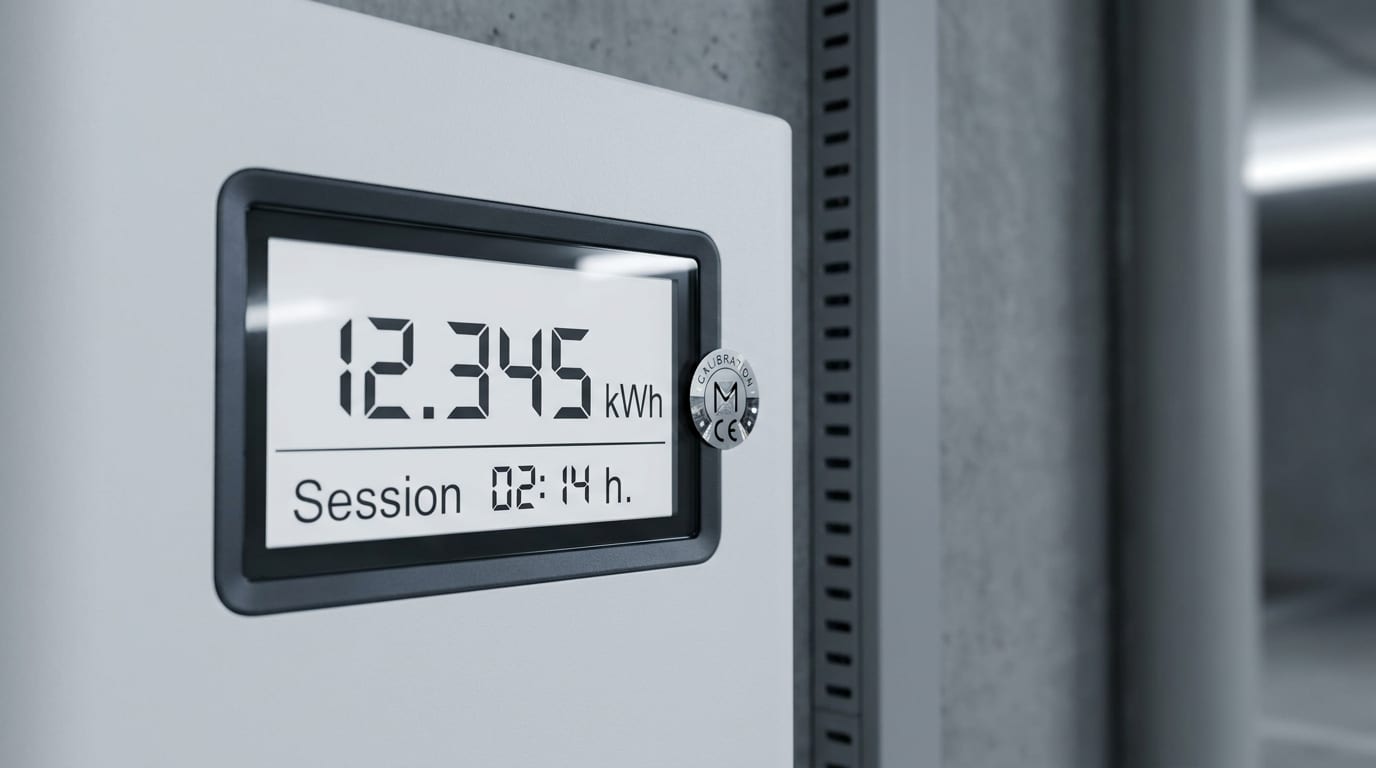
Eichrecht-Compliant Wallbox for Company Cars — MID Isn't Enough
Why MID certification alone doesn't cover company-car billing: Eichrecht explained, PTB requirements, signed measurement data — what employers must verify.

Wallbox for Company Cars: Employer Rollout 2026
Roll out wallboxes across a company-car fleet: hardware ownership vs. subscription, company-car policy, multi-location scaling — the practical guide.
Calibration-Law-Compliant Wallbox 2026 — Rules & Models
Calibration-law-compliant wallbox in Germany 2026: when it's mandatory, how it differs from MID-only wallboxes, which models qualify, and what to check before buying.
Ready for charging infrastructure in your building?
Schedule a free consultation — we'll advise you on the best options for your property.
Book a consultation