Short answer: The GEIG amendment takes effect on 1 January 2027. It tightens obligations for new buildings, for major renovations, and — for the first time in a way that really bites — for existing non-residential buildings with more than 20 parking spaces. For existing residential buildings with no renovation, it creates no new obligation at all. If you manage an apartment building in the existing stock, GEIG does not require you to retrofit anything. That is the answer most coverage of this law buries.
What this is about
The Gebäude-Elektromobilitätsinfrastruktur-Gesetz (GEIG) transposes the European buildings directive (EPBD) into German law. The amendment was passed by the Bundestag and Bundesrat in July 2026 and published in the Federal Law Gazette; the new requirements apply from 1 January 2027.
Until then the existing GEIG continues to apply. That matters for planning: projects completed in 2026 still fall under the old thresholds.
Who has to do what
| Building | Trigger | Obligation from 1 Jan 2027 |
|---|---|---|
| New residential | more than 3 spaces | at least 50 % of spaces pre-cabled, the rest with cable infrastructure, at least 1 charging point |
| New non-residential | more than 5 spaces | 50 % pre-cabled, rest with cable infrastructure, 1 charging point per 5 spaces |
| Residential, major renovation | more than 3 spaces | pre-cabling and cable infrastructure — a finished charging point is not generally required here |
| Non-residential, major renovation | more than 5 spaces | as for new non-residential |
| Existing non-residential (no renovation) | more than 20 spaces | 1 charging point per 10 spaces or cable infrastructure for 50 % of spaces |
| Existing residential (no renovation) | — | no obligation |
A “major renovation” only triggers the obligation if work is being done on the parking area or its electrical infrastructure anyway. Insulating a façade does not count.
The urgent case: existing non-residential buildings
This is the only category with a hard deadline and no construction trigger. If you hold an office, commercial or mixed-use property with more than 20 non-publicly-accessible parking spaces, you have to deliver by 1 January 2027 — with no renovation required to set the clock running.
For portfolios, that is the real news. Asset managers and property managers with mixed holdings almost always have assets in exactly this category, and the deadline runs without a construction project to trigger it. So the sensible first step is not a quotation but an inventory: which assets have more than 20 spaces, and are they residential or non-residential?
The most common misreading: existing apartment buildings
There is a widespread reading that GEIG forces owners of apartment buildings to retrofit. It does not. For an existing residential building with no construction work, no obligation arises — neither pre-cabling nor a charging point. The European directive is deliberately reticent here too, even though existing stock makes up the bulk of the building base.
For residential property managers and owners that is a relief — and a clarification: the pressure here does not come from GEIG, but from three other directions.
1. Residents’ legal right. Since the German condominium reform, owners under § 20 WEG and tenants under § 554 BGB have a right to consent for installing a charging option at their own expense. That is the mechanism that actually generates requests in the existing stock — not GEIG. It arrives one at a time, unannounced, per parking space.
2. The cost trap of one-off connections. That is exactly where the expensive pattern comes from: each individual request is solved as its own project, with its own supply line, its own billing and its own vendor. After five or six requests the garage holds a patchwork that cost more than a planned base installation and can no longer be operated cleanly.
3. Funding. Subsidies for charging infrastructure in multi-party buildings make the planned route additionally attractive — see funding for charging in multi-party buildings and the step-by-step application guide.
So those acting in the residential stock do so not because of a deadline, but because the planned solution is cheaper than the unplanned one. That is a better argument than an obligation that does not exist.
What “pre-cabled” means in practice
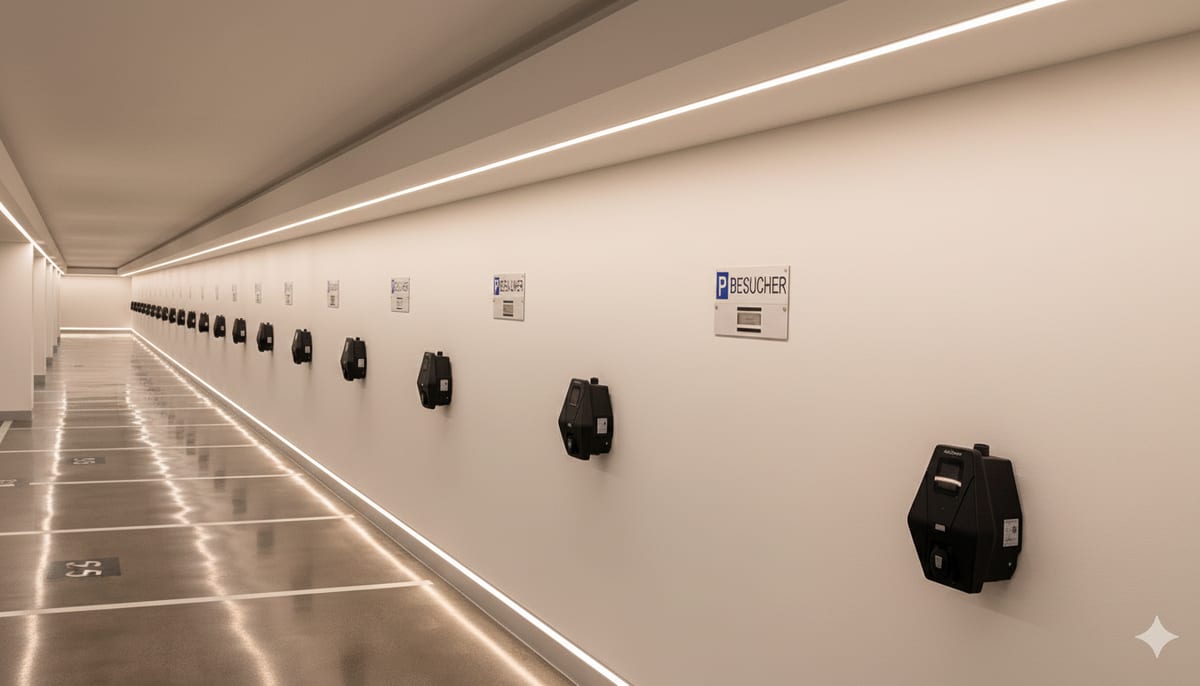
The core of the amendment is not the charging point but the cable infrastructure. In the new-build and renovation cases the law mostly requires preparation, not hardware: conduits, routes and supply lines onto which a charging point can later be fitted.
That is economically sensible — and it is exactly where projects are won or lost. Laying the electrics once for the whole garage while the trades are already on site is far cheaper than retrofitting space by space later. On larger sites, infrastructure costs commonly run €500–2,000 per parking space before a single wallbox is mounted — and the largest single item is often not the power, but the data network to every space.
That item can be deleted. If charging points authorise their users locally over Bluetooth and load is balanced over a dedicated wireless network between the charging points, no space needs a network cable — and the garage works without mobile reception. How that looks technically is covered in turnkey charging infrastructure for underground garages.
Smart charging becomes mandatory
Newly installed and replaced charging points must support smart charging and use non-proprietary, non-discriminatory communication protocols. In practice: charging power has to be controllable, and that control must not be locked into a single manufacturer’s closed system.
For system selection that is a concrete criterion — alongside § 14a EnWG, which already requires controllability for the grid connection.
What to do now
- Sort the portfolio. Residential or non-residential, number of spaces, planned renovations. Only that tells you which assets have a deadline at all.
- Prioritise existing non-residential buildings over 20 spaces. The only group with a date that no construction project has to trigger.
- Use upcoming renovations. If work is happening on the parking area anyway, pre-cabling is cheapest there — and from 2027 it is also mandatory.
- In residential stock, act by plan rather than by reaction. Not because of GEIG, but before individual requests under § 20 WEG / § 554 BGB produce the patchwork.
Frequently asked questions
As the manager of an existing apartment building, do I now have to retrofit charging points? No. For existing residential buildings without a major renovation, the GEIG amendment creates no retrofit obligation.
When does the amendment apply? From 1 January 2027. Until then the existing GEIG applies with the old thresholds.
My office building has 25 parking spaces and is not being renovated. Am I affected? Yes. Existing non-residential buildings with more than 20 spaces fall under the obligation from 1 January 2027 — one charging point per ten spaces, or cable infrastructure for half the spaces.
Does a façade renovation count as a “major renovation”? For GEIG what matters is whether work is done on the parking area or its electrical infrastructure. Measures unrelated to that do not trigger the obligation.
Do I have to build charging points immediately, or is preparation enough? In most cases the law requires cable infrastructure or pre-cabling; an actual charging point is required for new builds and for existing non-residential buildings, but not generally for residential renovations.
Rather plan it properly from the start?
We build charging infrastructure for underground garages and multi-party buildings — pre-cabled for the whole property, with no network cable to each space, and calibration-compliant per-user billing. Talk to us or look at the HeyCharge operator model.
As of 15 August 2026. This article reflects the state of the GEIG amendment following its publication in July 2026 and does not constitute legal advice. For a binding assessment of a specific property, please consult the statutory text and, where appropriate, legal counsel.
Related topics
Related articles

German Wallbox Funding 2026: Step-by-Step Application
Step-by-step PwC application: preparation, portal, identity check, approval. Practical notes on pitfalls, deadlines and documents for HOAs and landlords.
EV Charging in German Multi-Unit Buildings: 2026 Grant (€2K)
Germany's €500M federal grant for EV charging in multi-unit buildings 2026: up to €2,000/space, deadline Nov 10. What property managers must prepare now.
Turnkey EV Charging for Your Underground Parking Garage
HeyCharge installs and operates turnkey EV charging for multi-family buildings, offices, and underground garages — no IT overhead, no internet at the charger.
Ready for charging infrastructure in your building?
Schedule a free consultation — we'll advise you on the best options for your property.
Book a consultation