
TL;DR: On 15 April 2026 the German federal government opened a €500 million funding program called “Laden im Mehrparteienhaus” (Charging in Multi-Unit Buildings). It funds charging infrastructure in residential buildings with three or more units — up to €2,000 per parking space. Applications run in three parallel tracks (WEG / HOA, private landlords / SME, and large housing companies). Submission deadlines: 10 November 2026 (general) and 15 October 2026 (large housing operators). This guide summarises what German property managers, HOA boards and institutional real estate owners need to know now — and what the government’s own page doesn’t say.
The program in one sentence
The federal government is putting €500M behind the build-out of private charging infrastructure in multi-unit residential buildings — explicitly in the existing building stock. The goal is to fix the one place where EV adoption in Germany has been structurally stuck: charging where people actually live.
Official application portal and binding regulations: laden-im-mehrparteienhaus.de. Every figure in this guide refers to the federal announcement of 15 April 2026 and the public portal. The legally binding conditions live in the Förderrichtlinie (funding regulation) and in the application portal itself — not here.
Who can apply?
The program runs in three parallel funding calls. You apply to one — not all three.
1. Wohnungseigentümergemeinschaften (WEG / HOAs) Condominium owner associations in residential properties. The WEG applies as a legal community, typically represented by its administrator (Verwaltung).
2. SMEs and private landlords Small and medium-sized enterprises plus private owners holding residential real estate for rent — e.g. a private owner of a multi-family building, or a property manager running a small portfolio on behalf of individual owners.
3. Large housing companies and institutional portfolios Institutional owners of large residential stock — housing associations, asset managers, REITs, pension funds. This track has its own earlier submission deadline (see below).
Building eligibility (all three tracks): the building must have three or more residential units predominantly used for residential purposes. Pure commercial properties fall outside this program — they have other funding paths (overview on our funding page).
What’s funded — and how much?
The program funds the acquisition and installation of private charging infrastructure. Per the federal announcement, this explicitly includes the grid connection and the required construction work — not just the wallbox at the end of the cable, but the full chain from the sub-distribution board to the charging point.
The grant per parking space depends on the level of build-out:
| Parking space build-out | Max. grant |
|---|---|
| Pre-cabling only (no wallbox) | €1,300 |
| Pre-cabling with wallbox | €1,500 |
| Pre-cabling + bidirectional-capable wallbox (V2X) | €2,000 |
What exactly counts as “bidirectional-capable” — ISO 15118-20 support, VDE-AR-N compliance, grid-operator approval for back-feeding — is specified in the funding regulation in the portal. Anyone claiming the €2,000 tier needs hardware that is certified for it, not just marketed as V2X-ready.
Technical and structural requirements
The federal government names three hard thresholds:
- At least 6 parking spaces per building must be covered by the application. A project with five spaces falls out of eligibility.
- At least 20% of the building’s existing parking spaces must be pre-cabled — not just the ones you intend to activate. If you’re installing 6 active charging points in a building with 60 spaces, 12 must be pre-cabled.
- Maximum charging power: 22 kW per charging point. That’s well-suited to residential use — DC fast chargers don’t fall under this program anyway.
The 20% pre-cabling rule is where most projects will succeed or fail. Anyone treating this as a retrofit of individual parking spaces won’t get funded. Anyone treating it as a build-out of the full parking facility — with a properly sized grid connection, thought-through cable routing, and scalable load management — will.
Deadlines at a glance
| Event | Date |
|---|---|
| Application window opens (all three tracks) | 15 April 2026 |
| Submission deadline: large housing companies | 15 October 2026 |
| Submission deadline: WEGs, SMEs / private landlords | 10 November 2026 |
Submission runs exclusively through the application portal at laden-im-mehrparteienhaus.de/antragstellung. Late filings are, as a rule, not accepted.
Applicants in the large-institutional track effectively have just under six months to identify objects, secure owner-association or ownership resolutions, collect quotes, and file. For any WEG project that depends on the annual owners’ meeting, that’s tight.
Not sure whether your property qualifies? Book a 30-minute eligibility check → We verify grid capacity, parking count, and the right application track — free, no obligation.
What property managers and HOAs should prepare now
The government’s own page explains what gets funded. It doesn’t explain how to actually get an application across the finish line in the real world of WEG resolutions and aging grid connections. That’s the part most projects stumble on.
1. Assess the grid connection and parking facility
Before you collect quotes or draft an application, understand your starting point. What’s the existing grid connection capacity? How is the garage electrically serviced — via a central sub-distribution board or decentrally? How many parking spaces exist, who owns them (individual ownership, common property, rented), and what’s the physical situation (cable trays, fire compartments)?
An electrical planner or a specialised charge point operator typically has to answer these. Without this baseline, the application turns into a loop of follow-up questions from the granting body.
2. Line up the HOA resolution early
Under the WEMoG (German HOA modernisation law), every unit owner has a statutory right to charging infrastructure. The HOA can no longer refuse in principle — it only decides on the how. But executing in common areas still requires a proper resolution.
Practically: put the item on the agenda of the next ordinary owners’ meeting, prepare a resolution with costs, scope and funding scenario, organise the majority. If you only have one owners’ meeting between the window opening and the deadline, that meeting has to cover it — or you call an extraordinary meeting.
3. Pick scalable infrastructure
The 20% pre-cabling rule is an invitation to think big. But every extra cable run in an existing building costs money the grant doesn’t fully cover. The real question isn’t “how many charging points do we install today?” — it’s “how do we wire up the full facility today so that every further charging point over the next ten years is cheap to add?”
That calls for three things: intelligent load management that automatically brings new charging points online as they’re added. A data architecture that works even when there’s no mobile signal in the garage (background: charging infrastructure without mobile coverage). And calibration-law-compliant billing from day one (details), so nothing has to be rebuilt later.
4. Plan for post-grant operating costs
The grant covers capital expenditure — not ongoing operations. Cellular-connected wallboxes run €60 to €180 per charging point per year in SIM and platform fees. Over ten years, 20 charging points means up to €36,000 the grant never pays for. An offline-capable architecture without SIM dependency removes that line item entirely.
Just as important: who actually invoices the tenants? Most property managers don’t want that job. That means billing has to flow directly from the operator to the tenant, which in turn requires calibration-law-compliant hardware and a charge point operator sitting behind it.
5. Assemble application documents
Exactly which documents are required is defined in the portal. Federal programs of this kind typically ask for: proof of ownership, floor plan of the parking facility, technical concept including load management, quote from a certified electrical contractor, and evidence of eligibility (e.g. minutes of the HOA resolution). Budget several weeks to pull everything together, especially if the HOA resolution is still pending.
Rather delegate the checklist than work through it? Start the project conversation → We handle site survey, technical concept and quote as a ready-to-present package for your owners’ meeting.
How HeyCharge helps
HeyCharge is a charge point operator specialised in residential and commercial real estate. In the context of this program, three things matter:
We run the full project as a turnkey CPO. Planning, installation, grid-operator registration, commissioning, operation, maintenance, tenant billing — all from one source. You get a quote you can take straight into an owners’ meeting. Details: HeyCharge operator model.
Our hardware is eligible — and carries no ongoing SIM costs after the grant. Our patented SecureCharge technology works offline at the charging point; authentication, billing and load management all run without an internet connection at the wallbox. In underground parking — where these funded projects routinely happen — that’s the difference between “it works” and “it doesn’t.”
For HOAs that want to self-operate, we have a Self-Care package. If the community wants to keep operations in-house, we deliver hardware, billing platform and tenant onboarding as a packaged solution — without an external operator skimming the revenue. Details: WEG Self-Care.
Both models are compatible with the requirements of this federal program. Which one fits your property is something we work out in a 30-minute initial call — free, no strings attached.
Frequently asked questions
Do existing wallboxes count for the application? The funding regulation refers to acquisition and installation of new infrastructure. Already-commissioned wallboxes are not eligible in most federal programs of this kind. The binding answer is in the portal’s regulation document.
Can we bundle several buildings into one application? Larger owners in the third track (housing companies) can usually file portfolio applications. For WEGs and SMEs, one application per building is typically the rule. Bundling specifics: see the portal.
Does §554 BGB (a tenant’s right to a wallbox) still apply? Yes. §554 BGB obliges landlords to consent to structural changes for the purpose of EV charging. The new federal funding supplements this individual right with a building-wide funding path — it doesn’t replace it.
§14a EnWG — do funded charging points have to be grid-operator-dimmable? Every new charging device over 4.2 kW in Germany has had to be grid-operator-controllable since January 2024 under §14a EnWG. That applies independently of funding, to any new wallbox above that threshold. Compliant hardware handles it natively.
Does billing have to be calibration-law (Eichrecht) compliant? If electricity is resold — which means tenants pay for the power they charge — yes. In multi-unit residential buildings that’s nearly always the case. Wallboxes without MID-certified meters are practically ruled out. Background: Eichrecht-compliant billing.
Can HeyCharge file the application for us? We handle the full technical and commercial preparation — site survey, technical concept, cost quote, grid-operator coordination. The application itself has to be filed by the eligible party (owner, HOA, administrator); we supply the documentation.
What if the €500M runs out before the deadline? Deadline-based federal programs without first-come-first-served mechanics usually run a selection process after the deadline closes. Whether this program includes a first-come element is specified in the regulation. Practice across comparable German federal programs shows: filing early rarely hurts, but filing on time almost always suffices.
Summary
“Laden im Mehrparteienhaus” is the largest, most narrowly-tailored funding program for residential charging infrastructure Germany has ever offered. €500 million, up to €2,000 per parking space, three parallel application routes, a window of roughly six months. Anyone who gets a project across the line in that window cuts their capital expenditure by 30 to 60 % — without changing the economics of ongoing operation.
The bottleneck isn’t the funding. The bottleneck is organisational preparation: HOA resolutions, technical concepts, correctly sized grid connections, defensible quotes. Every week you invest in preparation now is a week of calm in the autumn.
Next step:
Book a call → (30 minutes, free, no obligation — we’ll clarify whether your property is eligible and which application track fits)
Related reading
- Wallbox subsidy WEG 2026 — overview — Application, conditions, full-service solution with HeyCharge
- German Wallbox Funding 2026: Step-by-Step Application — the application path from preparation to funding decision
- Company-car home charging: billing & tax 2026 — When employees with company cars live in funded multi-family buildings
- EV charging infrastructure for multi-family buildings — solution overview for asset managers, property managers and HOAs
- GEIG 2027: what applies to your building — and what doesn’t — which obligations the amendment actually triggers, and why existing residential stock isn’t one of them
Note: This guide summarises the state of information as of 20 April 2026. Binding conditions, deadlines, and documentation requirements are defined exclusively in the funding regulation and the official application portal at laden-im-mehrparteienhaus.de. Nothing in this article constitutes legal or funding advice.
Related articles
German Wallbox Funding 2026: Step-by-Step Application
Step-by-step PwC application: preparation, portal, identity check, approval. Practical notes on pitfalls, deadlines and documents for HOAs and landlords.
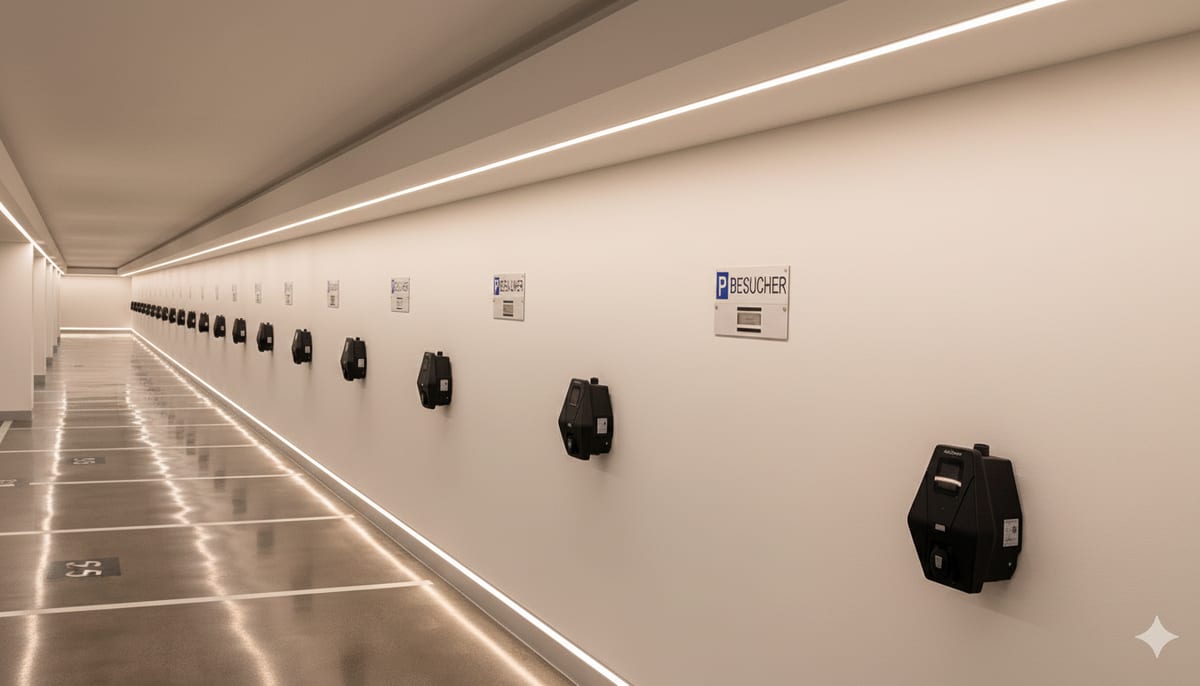
GEIG 2027: What Applies to Your Building — and What Doesn't
Germany's GEIG amendment takes effect 1 January 2027. Much changes for new builds and existing non-residential buildings — nothing for existing apartment stock.
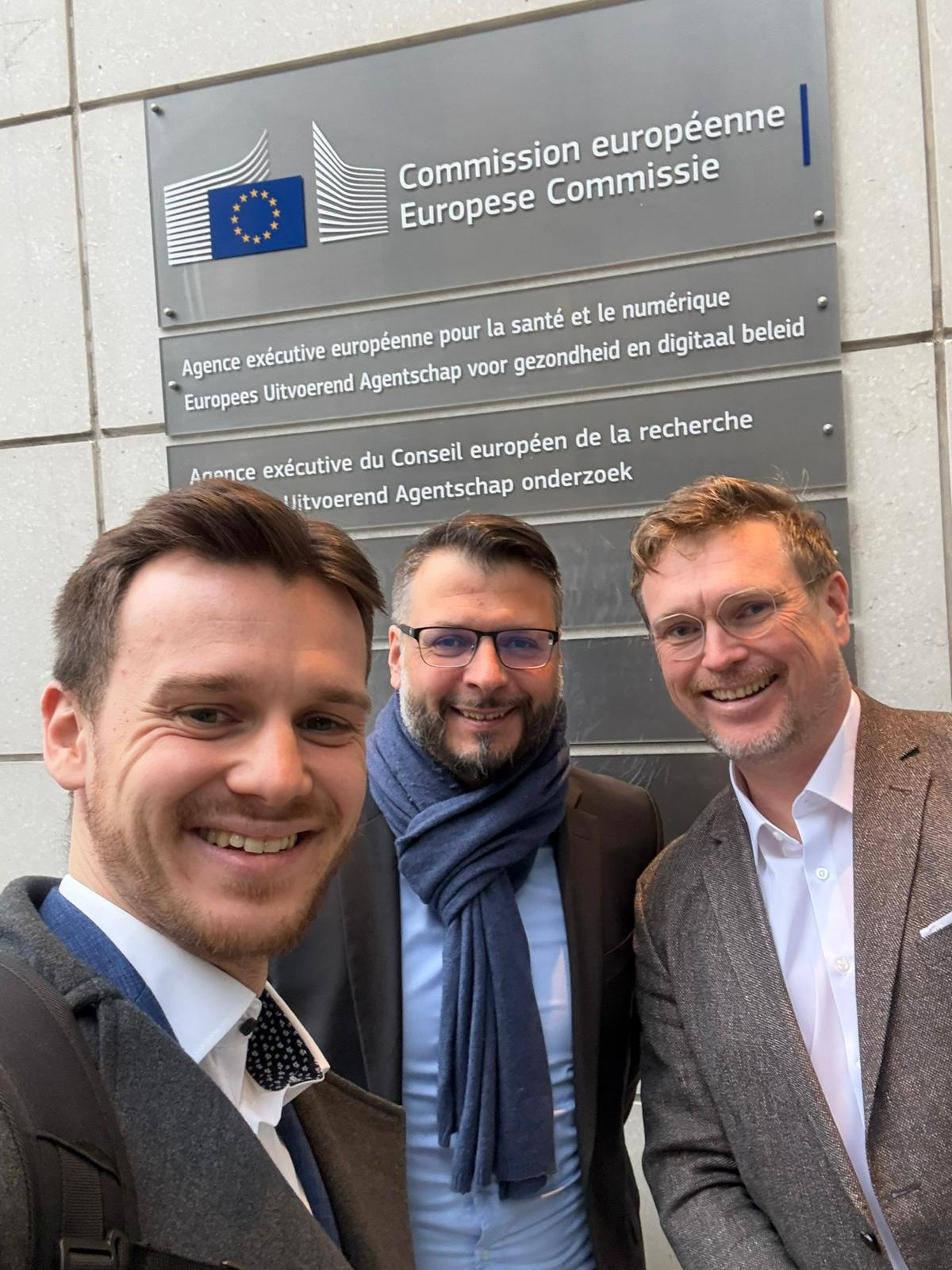
HeyCharge Wins €2.5 Million European Innovation Council Grant to Democratise EV Charging for Europe's Apartment Dwellers
EIC Accelerator funding will advance HeyCharge's patented SecureCharge FLEX technology, delivering 100% reliable charging and cutting installation costs by more than 40%.
Ready for charging infrastructure in your building?
Schedule a free consultation — we'll advise you on the best options for your property.
Book a consultation