Short answer: The application for Germany’s 2026 wallbox funding runs exclusively online through the portal of the project sponsor PwC. Plan four to eight weeks between document preparation and the funding decision, counted from the point at which all documents are complete. This guide walks through all five steps: preparation, registration, application form, identity check, and submission. With everything prepared in advance, the application itself takes less than an hour to complete — the bottleneck is the preparatory work, not the portal.
Before you start: the three-week pre-application principle
The most common reason for rejected applications is not a portal mistake — it’s a contract already signed with the installer before submission. The funding regulation is strict: an application may only be submitted if the project has not yet begun. “Begun” in funding law means: a supply or service contract signed, a deposit paid, materials ordered.
We therefore recommend the three-week pre-application principle: three weeks before the planned application date, all technical quotes should be in hand — but nothing ordered. Only after the funding decision (or, depending on the program variant, after an official application confirmation with permission to start) is the contract signed. Cutting corners here puts the entire grant at risk.
A full overview of the program logic, subsidy levels and all three funding calls is in the practice guide on the “Charging in Multi-Family Buildings” 2026 program.
Step 1 — Prepare your documents
The application itself is manageable. What takes time is the documentation. The requirements vary slightly across the three application groups (HOAs, SMEs/private landlords, large housing companies); the core is identical.
Standard documents for any application:
- Proof of ownership of the applicant — land registry extract or certified purchase contract. Recency: not older than six months.
- Proof of parking-space count — site plan or extract from the partition declaration with parking-space allocation.
- Connection diagram of the existing building grid connection including connection capacity in kVA.
- Technical quote from the installer — signed but not commissioned — with concrete unit counts, wallbox model, load management, and gross sum.
- HOA resolution (for HOA applicants) — formal resolution on the installation of charging infrastructure. Can be submitted up to six months after the funding decision, but ideally is in place before applying.
- Applicant’s IBAN for disbursement.
What you don’t need to assemble yourself if you work with HeyCharge: the technical quote including load-management concept, the parking-space inventory in the funding-eligible format, and a plausibility check before submission. We deliver these as a complete package — countersigned by the applicant, submitted via the portal.
Rather hand off the application? HeyCharge takes over the entire submission as part of the complete package — your share from €599 per parking space →. We prepare all documents, submit the application, and run the project.
Step 2 — PwC portal: registration
The official application portal is at laden-im-mehrparteienhaus.de/antragstellung. The natural person submitting the application on behalf of the owner registers first — i.e. the owner, the HOA administrator, or an authorized representative.
Registration requires:
- First and last name, address, telephone, email
- Role (owner / HOA administrator / authorized representative)
- power-of-attorney upload if not the owner registering themselves
After registration you receive a confirmation email with login credentials. The account remains permanently active — you can later submit further applications for other properties under the same account.
Practical tip: use a functional email address (“[email protected]”), not a personal one. If the responsible person leaves the company, the access stays with the organization.
Step 3 — Fill out the application form
Inside the portal you first select the application group (HOA, SME/private landlord, or large housing company). Choose carefully: a later correction requires a full re-submission.
The form has five sections:
a) Project details Building address, number of residential units, total number of existing parking spaces, number of parking spaces to be funded. Note the 20% pre-wiring rule: at least 20% of all existing parking spaces must be pre-wired, not only those with active charging points.
b) Technical specification Wallbox model, charging power per point (max. 22 kW), load-management concept, planned grid connection capacity. To claim the €2,000 rate for bidirectional wallboxes, certified ISO 15118-20 hardware must be specified here.
c) Cost calculation Gross project sum, breakdown by parking-space type (pre-wiring only / pre-wiring + wallbox / bidirectional). The portal automatically calculates the funding share and shows your remaining co-payment.
d) Schedule Planned start (earliest after funding decision), planned completion. Practical reference: 4–8 months from decision to commissioning.
e) Declarations Confirmation of funding eligibility, that the project has not yet begun, that no other funding covers the same project (no double funding), and that the funded infrastructure will be operated as intended for five years.
Save regularly — the portal ends inactive sessions after 30 minutes. Inputs are buffered, but not indefinitely.
Step 4 — Identity verification
After completing the form, the applicant’s identity is verified. The portal accepts two procedures:
- Online ident by video chat with national ID (5–15 minutes, instant confirmation).
- PostIdent at a post office (3–7 working days).
Important: identity verification must be completed within 14 days of submission. Delays trigger automatic rejection — the application then has to be resubmitted, with corresponding loss of position in queue if the budget is oversubscribed.
We clearly recommend the online ident procedure. The 14-day window is tight, and PostIdent shifts postal-delivery risk onto the applicant.
Step 5 — Submission and funding decision
Clicking “Submit application” hands the project over to the project sponsor for review. You immediately receive an acknowledgment of receipt by email with the application ID — this ID is your reference number for all further communication.
What happens next?
- Receipt review (typically 1–2 weeks): completeness of documents, plausibility of statements, ownership.
- Substantive review (typically 2–4 weeks): funding eligibility, technical requirements, double-funding check.
- Funding decision: written approval with binding funding amount, conditions, and disbursement procedure.
Only after receiving the funding decision may you start the project — sign contracts, order materials, commission installers. Some program variants allow “early project start at own risk” already from application confirmation; this is in the individual confirmation letter and should not be assumed by default.
Prefer to have professionals submit the application? HeyCharge funding package — your share from €599 → We prepare all documents, submit the application, and accompany you to the funding decision.
Common pitfalls
These five mistakes appear repeatedly in PwC application case studies — and are all avoidable:
1. Project start before decision. Even a deposit to the installer is enough to invalidate the application. Wait for the decision.
2. Wrong parking-space count. The 20% rule applies to all parking spaces of the building, not only the assigned ones. Reporting only the 20 in-house spaces of a 60-space site will fail the plausibility check.
3. Overlooked double funding. Some German states (Baden-Württemberg, Bavaria, Hesse) had regional wallbox programs. Combining them with the federal grant is only allowed if both programs explicitly permit it — otherwise clawback.
4. HOA resolution too late. Even though the resolution may be submitted up to 6 months after the decision: without the resolution, no disbursement. Pushing it to the next annual owner meeting in eight months blocks the money.
5. Wrong application group. A private-landlord LLC choosing the HOA call (or vice versa) gets a substantive rejection — and has to start completely over.
Frequently asked questions
How long does processing take? On average 4–8 weeks once documents are complete. With high application volume in the first weeks after program start, it can take longer.
Can I bundle multiple properties into one application? No, exactly one building per application. To fund a portfolio, parallel applications must be submitted.
What does the application cost? At PwC: nothing. External advisory fees can be charged separately — at HeyCharge, application support is part of the complete package without extra cost.
What happens if the budget is exhausted before my application? Then the funding call is closed. A follow-up round in 2027 is not guaranteed. Early submission — ideally in the first weeks after April 15, 2026 — is therefore essential.
Do I need a tax advisor? Not for the application itself. For the later booking of the grant as an investment subsidy it can make sense to coordinate with accounting — particularly for actively rented properties and pass-through to tenants under modernization-rent rules.
Rather have us take it over?
HeyCharge bundles application, planning, installation, and operations into one complete package — your share from €599 per parking space after funding. You give us access to the building, we take care of the rest.
Related topics
- Charging in Multi-Family Buildings 2026 — Practice Guide — the program at a glance: subsidies, calls, requirements.
- German LIS Funding 2026 — Complete Solution — what HeyCharge handles in the funding package: planning, installation, application support, operation.
- Turnkey EV Charging in Underground Garages — how the construction part of a funded project unfolds in practice.
- EV charging for multi-family buildings — the full solution for multi-unit properties at a glance.
Related articles
EV Charging in German Multi-Unit Buildings: 2026 Grant (€2K)
Germany's €500M federal grant for EV charging in multi-unit buildings 2026: up to €2,000/space, deadline Nov 10. What property managers must prepare now.
GEIG 2027: What Applies to Your Building — and What Doesn't
Germany's GEIG amendment takes effect 1 January 2027. Much changes for new builds and existing non-residential buildings — nothing for existing apartment stock.
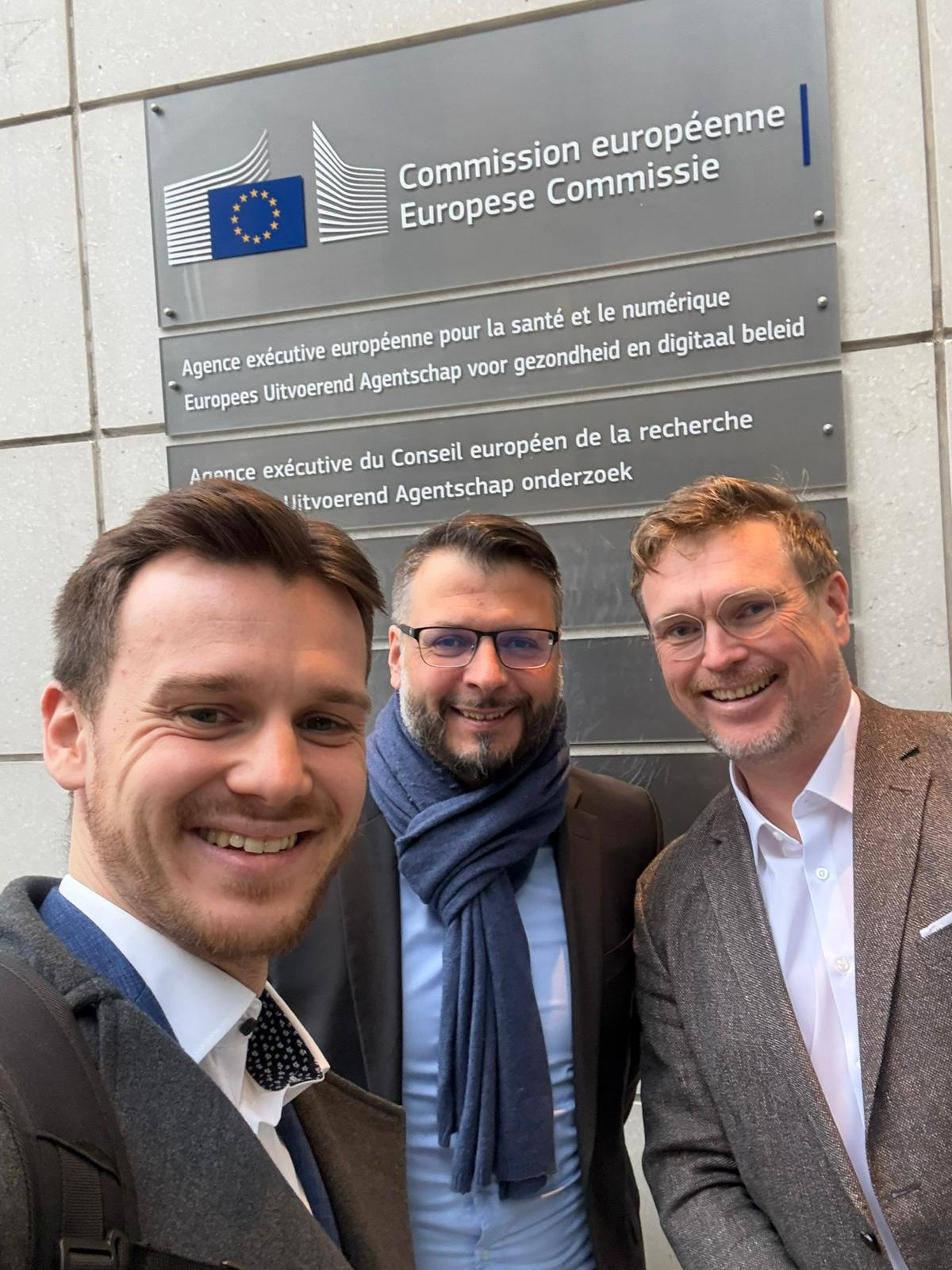
HeyCharge Wins €2.5 Million European Innovation Council Grant to Democratise EV Charging for Europe's Apartment Dwellers
EIC Accelerator funding will advance HeyCharge's patented SecureCharge FLEX technology, delivering 100% reliable charging and cutting installation costs by more than 40%.
Ready for charging infrastructure in your building?
Schedule a free consultation — we'll advise you on the best options for your property.
Book a consultation