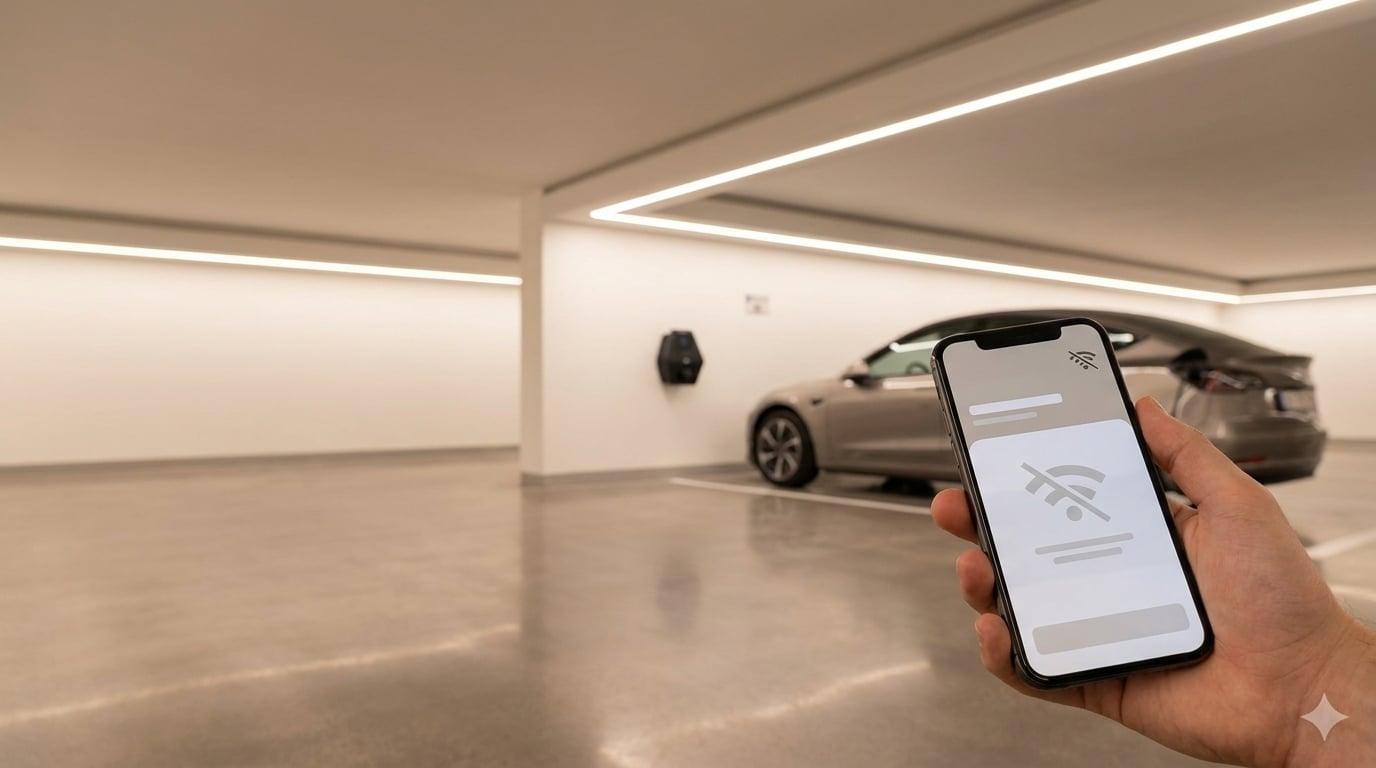
Short answer: Charging apps fail in underground garages and parking structures because reinforced concrete blocks mobile signal. It’s not just your phone that drops coverage — the station itself usually does too, since it’s typically connected to the operator’s OCPP backend over an LTE modem. There are driver-side workarounds (NFC, RFID card, Google Pay), but they all stay workarounds. The real fix sits with whoever operates the charging infrastructure: systems that don’t need internet at the charging point solve the problem completely.
Why your charging app fails in the underground garage
The physics is simple. Mobile signals — 4G/5G across 700 MHz to 3.8 GHz — are strongly attenuated by reinforced concrete. A 25 to 40 cm concrete floor slab with rebar typically causes 20 to 40 dB of signal loss. Two slabs is enough to push even the strongest carrier below the usable threshold. Metal partitions, sprinkler piping, and ventilation shafts finish the job.
When your smartphone has no signal in the underground garage, the charging app can’t reach the operator’s backend — it can’t authenticate, can’t fetch tariff info, can’t open a payment session.
And: in many cases the charging station itself has no signal either. Public AC stations are usually connected to the operator’s OCPP backend via a built-in LTE modem. When that modem drops in the underground garage, RFID whitelists that rely on backend lookup stop working, and metering data transmission stops as well. Both ends — driver app and station — go offline.
This isn’t a question of your mobile carrier. It’s building physics.
What you can do as a driver today
As long as the charging infrastructure works classically, these are your workarounds:
1. NFC handshake from within the app
Several major providers (EnBW, Tank-E Netzwerk, ChargePoint) support starting a session via NFC from the app: you open the app once while you still have signal, pull a daily token, and then tap the phone against the station’s RFID reader. Authentication happens locally between app and station reader. Works cleanly in a fair share of cases — and is the technically most elegant driver-side fix.
Prerequisite: the provider must support the feature and your phone must have NFC enabled. Check the app under “Start session” or “NFC card.”
2. Start the app before you drive in
If you select the station on a map view before entering the garage and prepare the session, many apps keep the session warm. You drive in, plug in, and the session initializes. Doesn’t always work but often does.
3. Plug in, walk out, start from outside
A workaround frequently mentioned in forums: plug in, walk back toward the garage entrance, start the session from where you have signal, walk back to the car. Inelegant but reliable, as long as the station had backend contact at least once during the day.
4. Credit card or Google Pay / Apple Pay
Since April 2024, new public charging points above 50 kW in the EU must accept card payments (AFIR regulation — EC, Visa, Mastercard, Apple Pay, Google Pay). The card terminals work offline-capable (EMV transaction with later backend processing). From 2027 the mandate extends to existing HPC stations and to AC sites with total output above 50 kW. For a single AC charging point in a residential underground garage, this usually doesn’t apply.
Downside: you pay the ad-hoc rate, which is almost always above the same operator’s app tariff — often 20 to 50 % more.
5. Physical charging card as backup
One of the common roaming cards (EnBW mobility+, Shell Recharge, Aral Pulse, ADAC e-Charge) in the glove box. RFID lookup against the station’s whitelist works offline in most cases. Downside: you pay the expensive roaming rate, often 30 to 100 % above the operator’s app tariff.
6. Wi-Fi calling and VoWiFi
Some forum commenters suggest enabling Wi-Fi calling and using the guest Wi-Fi of a nearby business, if available. Good enough for a voice call, rarely enough for the charging app — which needs stable data throughput, not voice.
Why none of this is satisfying
Every one of these workarounds sits somewhere between “awkward” and “expensive”:
- The cheap app tariff stays out of reach when you fall back to card or Apple Pay.
- Live prices and tariff choice aren’t visible at the terminal.
- Session monitoring — how many kWh have been delivered, how much time left — isn’t on your phone because the app doesn’t connect.
- The overall user experience becomes inconsistent: sometimes NFC works, sometimes the card, sometimes nothing. Nobody wants to spend five minutes doing trial-and-error in front of every station.
That is, predictably, a common reason to avoid charging in parking structures — even when the infrastructure is physically there.
What operators could do — and why they often don’t
There’s no physical reason a charging station in an underground garage has to be offline. Operators have options:
- LTE directional antenna plus repeater — barely operable in practice, because active repeaters in Germany may only be permitted by the mobile network operator. Passive repeaters have only a few metres of range.
- Ethernet to every charging point — clean solution, but €500 to €2,000 per bay including fire-compartment penetrations. For a 20-bay underground garage: €10,000 to €40,000 in cabling alone before a kWh is delivered.
- Public Wi-Fi access point next to the station — cheap, but OCPP over guest Wi-Fi is unreliable and a security mess.
The reason none of this tends to happen: charging infrastructure is often specified like plumbing — pick a component, hire an electrician, done. The connectivity question slips to the back of the list, and the result is what you see in front of the station.
The clean fix sits one level deeper: offline-first architecture
Instead of retroactively bringing internet to every charging point, the architecture can be designed so the charging point doesn’t need an internet connection in the first place. Here’s how:
- Authentication: Bluetooth Low Energy directly between smartphone and wallbox. The driver opens the app above ground, the app pulls a daily authorization ticket from the backend, and the handshake with the wallbox happens locally — without signal on either side.
- Meter data transmission: Readings are signed in an Eichrecht-compliant way at the wallbox itself and stored there. When the user leaves the garage, the smartphone transmits the data to the backend over Bluetooth.
- Load management: Runs locally as a mesh between wallboxes, not via the cloud.
HeyCharge has been building this architecture since founding and today operates it at over 135 sites in residential and commercial buildings. More detail: SecureCharge technology. It’s not a fix for the public highway fast-charging station — it’s the fix for charging infrastructure in your own residential, office, or parking building, where parking spots are individually assigned.
Conclusion
If you’re a driver and next time you’re standing in front of a charging station in an underground garage whose app won’t connect:
- Try NFC from the app (EnBW, Tank-E, ChargePoint support this).
- If the station is AFIR-compliant: card payment or Apple Pay / Google Pay.
- Otherwise: pull out the roaming card and accept the more expensive ad-hoc rate.
- And: complain to the operator. As long as nobody complains, no property manager and no parking operator will prioritize a retrofit.
If you’re an operator, property manager, or asset manager reading this because your tenants or users complain about exactly this problem — retrofitting mobile coverage into an existing underground garage is technically fiddly and legally tricky. It’s more pragmatic to pick an offline-first charging infrastructure at the next expansion stage, one that never produces this problem in the first place. Details on how to pick a suitable system: Planning charging infrastructure in underground garages — without mobile dependency.
Further reading:
Related articles
Planning Charging Infrastructure in Underground Garages and Parking Structures — Without Mobile Connectivity
Mobile signal doesn't penetrate reinforced concrete. Teams that plan charging infrastructure without factoring that in end up with unhappy users, expensive retrofits, and dropped OCPP sessions. This guide explains why LTE repeaters, Ethernet, and guest Wi-Fi aren't clean solutions — and how offline-first architecture eliminates the problem at the root.
Turnkey EV Charging for Your Underground Parking Garage
HeyCharge installs and operates turnkey EV charging for multi-family buildings, offices, and underground garages — no IT overhead, no internet at the charger.
GEIG 2027: What Applies to Your Building — and What Doesn't
Germany's GEIG amendment takes effect 1 January 2027. Much changes for new builds and existing non-residential buildings — nothing for existing apartment stock.
Ready for charging infrastructure in your building?
Schedule a free consultation — we'll advise you on the best options for your property.
Book a consultation