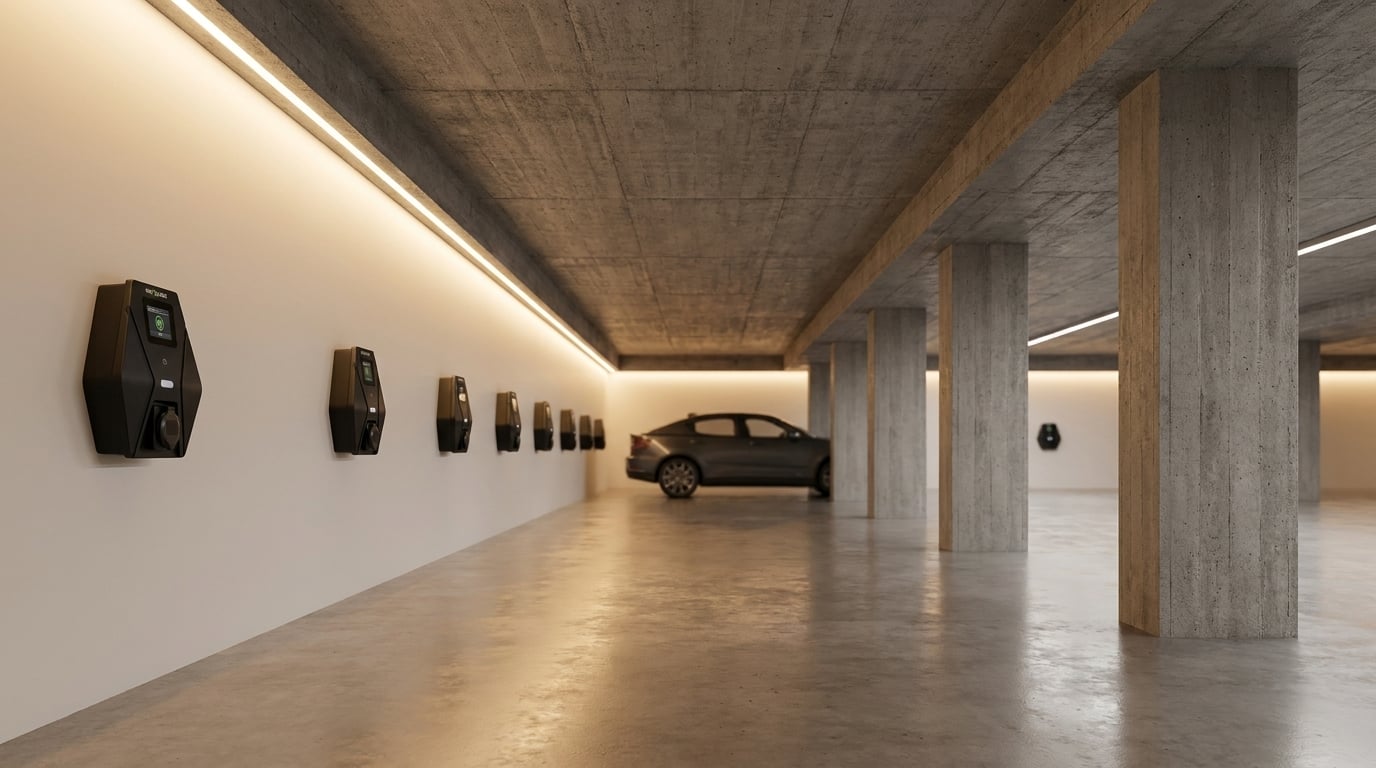
Short answer: The most common mistake in charging-infrastructure projects for underground garages and parking structures is treating mobile connectivity as an afterthought. Reinforced-concrete basements have no reception — and every retrofit “solution” (LTE directional antenna plus repeater, Ethernet to every bay, guest Wi-Fi) is either expensive, legally tricky, or operationally fragile. The better move: specify systems that don’t require internet at the charger.
This guide walks property managers, asset managers, and consulting engineers through why the connectivity question should drive the design — and lists the six questions every wallbox vendor must answer clearly before you sign.
The driver’s problem is your problem
Browse any German EV forum and you’ll find the same complaint in many variations: driver pulls into an underground garage, opens the operator’s app, the app fails to connect, the operator’s cheap app tariff is unreachable. Workaround: pull out one of the physical charging cards kept in the glove box for exactly this case — at an ad-hoc rate that is almost always more expensive than the same operator’s app tariff. Or: plug in, walk back to the entrance ramp, start the charge from there, walk back to the car.
If this is how your charging points get experienced, you inherit three problems at once:
- Support load on property management or facility management. Every failed app session turns into a complaint.
- Falling utilization. Users burnt once go looking for a more reliable option elsewhere.
- Missing billing data. When OCPP drops, sessions end up in inconsistent states; billing backends lose transactions or double-book them.
This is not a driver problem specific to a particular operator. It’s an architectural problem at the charging infrastructure itself.
Why there’s no reception in the underground garage
Mobile signals (4G/5G from 700 MHz to 3.8 GHz) are heavily attenuated by steel-reinforced concrete. A 25–40 cm concrete floor slab with rebar typically causes 20–40 dB of signal loss. Two slabs are enough to push even the strongest carrier below the usable threshold. Metal partitions, sprinkler piping, and service shafts finish the job.
Wi-Fi (2.4 GHz and 5 GHz) has the same physics, only worse. DAB+ and GPS likewise. This isn’t a carrier issue, it’s a building-physics issue.
And: the charging station itself typically sits on an LTE modem back to the operator’s OCPP backend. When mobile drops, it’s not just the driver’s app that loses data — the station does too: no RFID-whitelist authorization via backend lookup, no real-time metering data transmission, no load management that is calculated on a cloud backend.
Three common connectivity workarounds — and why none is clean
1. LTE directional antenna plus active repeater
The forum-popular fix: a directional antenna outside, an amplifier/repeater inside, broadcasting signal into the garage.
What works: For a single plant room (transformer bay, elevator machine room) this has been done for decades.
What doesn’t:
- Legal position: Active bidirectional cellular repeaters in Germany may only be operated by the frequency licensee — the mobile network operator — or with their explicit permission. A parking operator or property manager is not permitted to just put up a consumer repeater. Passive repeaters (antenna-to-antenna pass-through) don’t require permission but typically reach only 2–3 metres.
- Cost: Directional antenna €150–400, repeater €500–1,500, install and cable routing €500–1,200, plus ongoing maintenance. Per site: €1,500–3,000 one-off, plus risk.
- Network coverage isn’t a feature: A repeater for Network A doesn’t serve drivers on Network B. For three German carriers you’d need three parallel installations — each one permitted by the respective network operator.
Bottom line: for private buildings, not practically operable.
2. Ethernet/LAN to every charging point
The “proper IT” approach: structured cabling, every charging point gets a CAT6 run.
What works: Technically clean, long-term stable, independent of mobile coverage.
What doesn’t:
- Cost: €500–2,000 per parking bay depending on cable routing, fire-compartment penetrations (F30/F90 penetrations are non-trivial), switch infrastructure. For a 20-bay garage: €10,000–40,000 in cabling and active gear alone, before the first kWh is delivered.
- Fire protection: Every tray penetration through a fire compartment requires a certified seal. In existing buildings, retrofitting this is often hard to get signed off.
- Extensibility: Cable 10 charging points today and want to scale to 30 in three years? You cable three times.
Bottom line: defensible for new-build with GEIG-compliant conduit pre-installation. Rarely economical in existing buildings.
3. Public Wi-Fi / guest Wi-Fi next to the station
The pragmatic fix: an access point in the garage, drivers use Wi-Fi for payment, the station rides the same AP via OCPP.
What works: Cheap (an AP costs €150–500), fast to deploy.
What doesn’t:
- Reliability: Consumer Wi-Fi is not built for continuous OCPP traffic from a charging station. DFS channel changes in the 5 GHz band, broadcast storms, auto-reconnect bugs. OCPP sessions drop regularly.
- Security: Routing payment data and backend credentials through an unencrypted guest Wi-Fi is neither PCI-DSS nor GDPR compliant. Adding a VPN layer makes it more work than the effort you avoided.
- Support: The AP becomes a single point of failure that nobody owns. Loss of the building’s internet link = every charging point offline.
Bottom line: acceptable stopgap for 1–4 charging points, not a sound foundation for building-wide charging infrastructure.
The AFIR card-terminal mandate only solves part of the problem
Since April 2024, new public charging points above 50 kW must offer card payment (EC, Visa, Mastercard, Apple Pay, Google Pay) — a requirement from the EU’s Alternative Fuels Infrastructure Regulation (AFIR). From April 2027, the requirement extends to existing HPC stations and to AC stations with a site output above 50 kW.
That solves the payment problem for casual drivers — but it doesn’t solve:
- The tariff and subscription advantage of the app tariff (ad-hoc pricing stays higher)
- Live price display and session control on the user’s phone
- Billing in residential and office properties, where the operator bills the tenant directly and the tenant has no interest in swiping a card every time
For your underground garage or corporate parking structure, the AFIR card terminal is in most cases not the solution. It addresses public fast charging, not user-assigned charging at one’s own parking bay.
Eichrecht and §14a EnWG don’t need internet at the charger
A recurring misconception in procurement specs: “We need a cloud connection for Eichrecht and §14a EnWG.” Not quite.
Eichrecht (German Measurement and Calibration Act): The regulatory requirement is that meter data is cryptographically signed, demonstrably tamper-resistant, and verifiable for the customer. That can be satisfied elegantly with a signature at the wallbox itself and subsequent store-and-forward transmission — for instance, via the user’s smartphone when they leave the garage. A live internet connection at the charging point is not mandated.
§14a EnWG: Since January 2024, new charging equipment above 4.2 kW in Germany must be grid-operator-dimmable. The dimming request is communicated from the grid operator to the “control box” at the metering cabinet — from there it can be propagated locally via CAN bus, Modbus, or a mesh signal to the charging points. No cloud path required.
If a vendor tells you that Eichrecht or §14a mandates an internet connection at every charger, they either have a product that ignores the physics in underground garages, or they don’t know the regulation well enough.
Offline-first architecture: how it works elegantly
The alternative to “somehow get internet to every charging point” is: design the architecture so the charging point doesn’t need internet in the first place. The HeyCharge platform does this as follows:
- Authentication: Bluetooth Low Energy directly between smartphone and wallbox. The driver opens the app before entering the garage, the app pulls the daily authorization ticket from the backend, and the handshake with the wallbox happens locally — without internet on either side.
- Meter data transmission: Data is signed in an Eichrecht-compliant way at the wallbox and stored there. At the next charging session or when the user leaves the garage, data transfers via Bluetooth to the user’s smartphone and onward to the backend.
- Load management: Runs locally as a mesh between wallboxes. Charging points negotiate the available connection capacity among themselves, in real time, without a cloud round-trip.
- §14a EnWG dimming: The dimming instruction arrives locally from the control-box gateway and is distributed across the charging points by mesh. No internet required.
- Tenant billing: Eichrecht-compliant billing directly CPO ↔ tenant, without routing through property management.
Result: in a 50-bay underground garage you save €25,000–50,000 of Ethernet cabling, you don’t operate permission-requiring repeaters, and you don’t rely on guest Wi-Fi infrastructure as a single point of failure.
Checklist: six questions for the procurement spec
Before you award a wallbox contract, get each of these in writing:
- Does authentication work when the station has no internet connection? If the answer is “yes, via a local RFID whitelist” — how often is the whitelist updated, and how does roaming with eMSP cards work?
- Is meter data signed locally at the station in an Eichrecht-compliant way? Or only in the backend after upload? The latter means: no legally compliant billing for a session if the connection drops.
- How is §14a EnWG implemented when there’s no internet? Locally via the control box, or by cloud command? If by cloud command: what happens on network outage?
- How does load management between charging points work without the cloud? Local mesh, Modbus coupling to a local gateway, or cloud-based coordination? Only the first two work during a connectivity outage.
- What IT infrastructure is required on the building side? Which cables to where? Which access points? Which SIM cards? What recurring connectivity fees?
- What happens to meter data in a fault case? Concretely: a session has recorded 23 kWh, the connection drops — what does the tenant get billed, and how does the system reconcile state on the next upload?
If a vendor answers more than two of these with “our cloud handles it,” you’re talking to the wrong vendor for an underground garage.
Conclusion
Underground garages and parking structures are reinforced concrete. Reinforced concrete blocks mobile signal. Any charging-infrastructure plan that addresses this retroactively lands either at expensive and legally delicate repeater installations, five-figure Ethernet retrofits, or a fragile guest-Wi-Fi setup that ends up on property management’s desk.
The clean alternative is to ask the connectivity question before the hardware decision — and specify systems that don’t need internet at the charging point. HeyCharge has built and operated this architecture since its founding, and today runs it at over 135 sites with more than 2,500 parking bays, including in a strategic partnership with Vonovia.
Next step:
If you have a concrete project — residential, office, parking structure, or mixed use — let’s walk through the site situation in a short first call. Not a sales pitch, a technical and commercial read on your specific site.
Schedule a consultation → (30 minutes, free, no obligation)
Further reading:
- Charging Infrastructure for Your Underground Garage — Turnkey, Without IT Overhead
- Cybersecure EV Charging Without Network Access — when the connectivity gap is also a security question (government, defense, R&D).
- SecureCharge Technology — how charging works without internet
- Eichrecht-compliant billing
Related articles
Your Charging App Doesn't Work in the Underground Garage — Why, and What Actually Helps
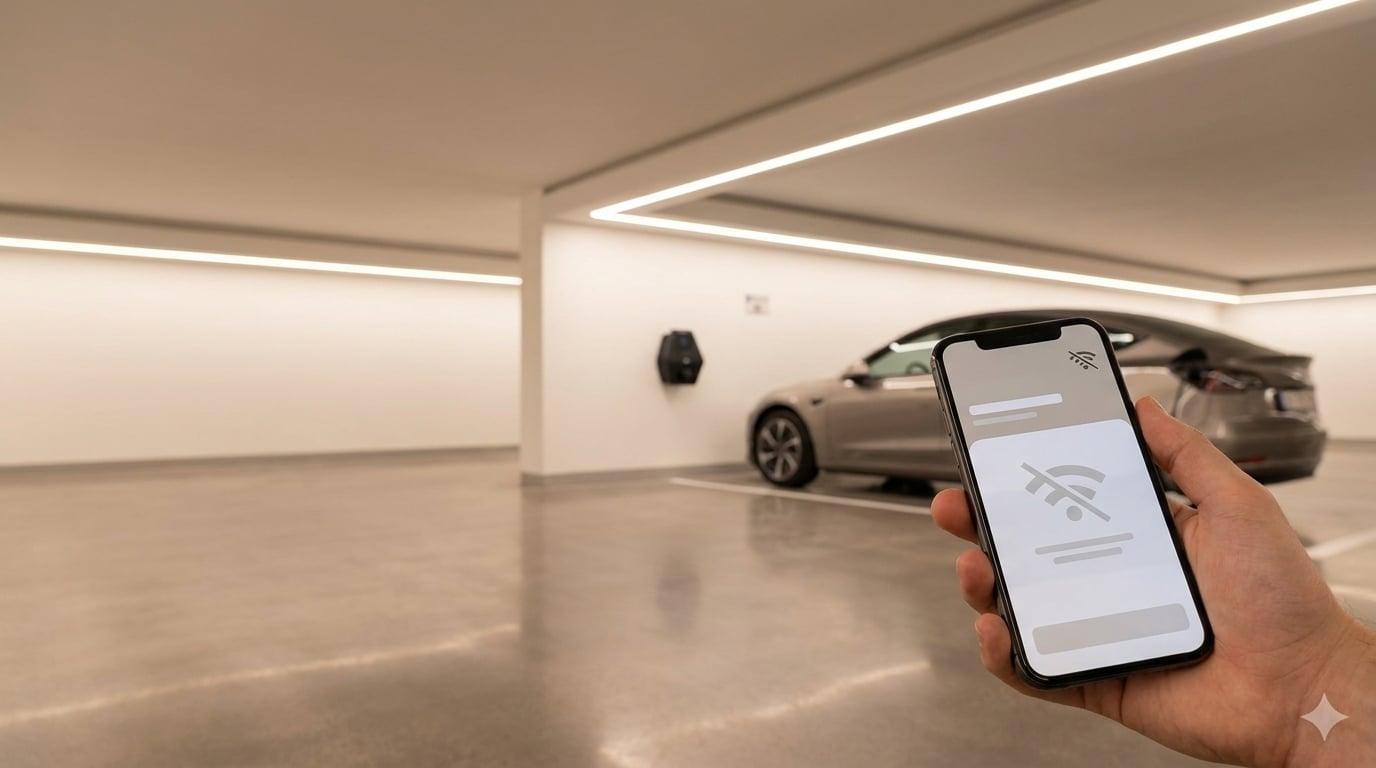
Charging point in the underground garage, the app fails to connect, the only option left is a pricey roaming card. A familiar frustration. This article explains why it happens, what you can do as a driver today — and why the real fix sits with whoever operates the charging infrastructure.
Turnkey EV Charging for Your Underground Parking Garage
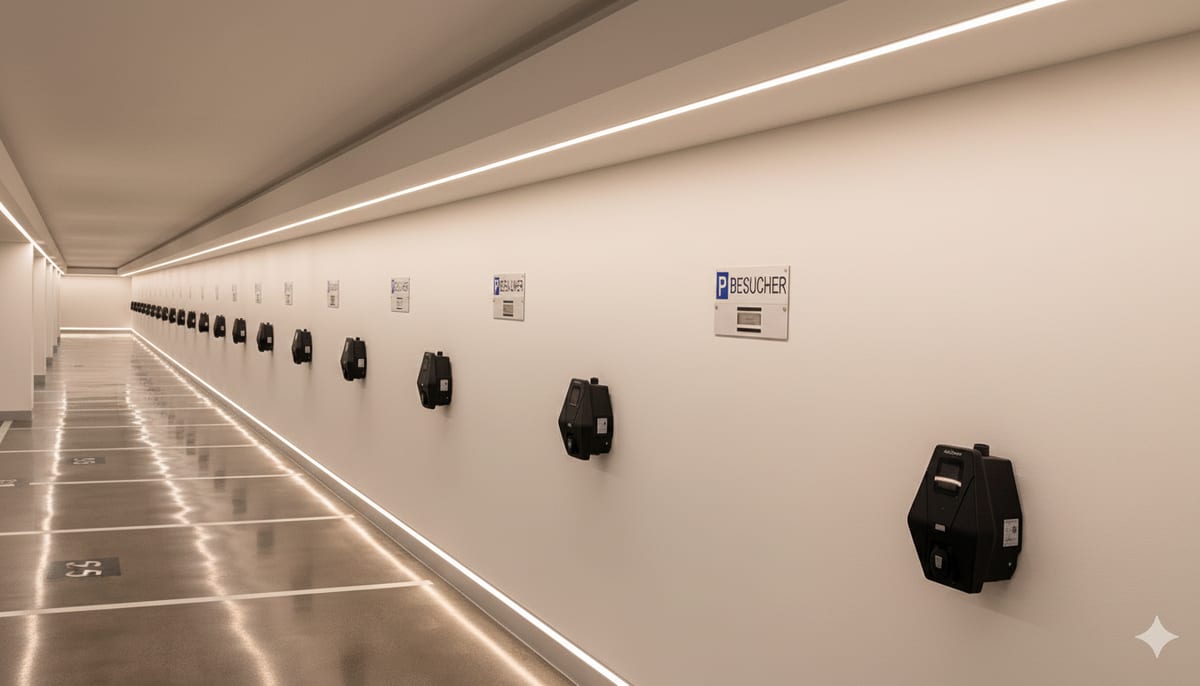
HeyCharge installs and operates turnkey EV charging for multi-family buildings, offices, and underground garages — no IT overhead, no internet at the charger.
GEIG 2027: What Applies to Your Building — and What Doesn't
Germany's GEIG amendment takes effect 1 January 2027. Much changes for new builds and existing non-residential buildings — nothing for existing apartment stock.
Ready for charging infrastructure in your building?
Schedule a free consultation — we'll advise you on the best options for your property.
Book a consultation