
Quick answer: A wallbox for a company car is a trivial hardware question — until it becomes a fleet question. With two or three EV company cars, employee-purchased wallboxes plus receipt reimbursement is fine. From ten drivers up it gets fragile: different hardware, different contracts, different Eichrecht problems. This guide shows employers which decisions to make before rollout — hardware ownership, company-car policy, scaling — so the model still works at 30, 100, or 300 drivers.
Why “the employee buys it themselves” breaks at scale
For small fleets the obvious path is: employee picks a wallbox, buys it, employer reimburses the receipt. Works beautifully — until:
- Employee A buys a smart wallbox without Eichrecht compliance. The electricity receipts are vulnerable.
- Employee B buys an Eichrecht-compliant box but sends Excel sheets instead of app receipts.
- Employee C moves to a different employer after 18 months. The wallbox stays — who owns it? Who maintains it?
- Employee D moves house. The wallbox at the old address has to come down — and go up at the new one. Who handles it?
From the HR side: more time on wallbox receipts than on workforce planning. From the employee side: a “weird side job” they weren’t hired for.
The tipping point typically arrives between 5 and 10 drivers — that’s when structured rollout becomes cheaper than the spreadsheet solution.
Decision 1: Hardware ownership
Three models exist:
Employee owns the box (receipt reimbursement) Low effort for the employer, but all the problems above. Tax-clean only with Eichrecht-compliant hardware — which many cheap wallboxes don’t deliver.
Employer owns the box (asset) Balance-sheet effect, depreciation, and at the end of the employment relationship the box has to be removed or scrapped. Works for stable fleets, not for high-turnover roles.
Subscription The employee receives the box through a specialist platform; the employer pays monthly per driver. No capex, no residual-value problem, take-back included. Most scalable model from ~5 drivers.
Retrofit adapter (MagicBox model) A fourth path — fits when the employee already has an Eichrecht-compliant smart wallbox on the wall: the employer ships a compact plug-and-play adapter — the HeyCharge MagicBox — which the employee plugs in themselves between wallbox and grid. No electrician, no new hardware investment, no bulky shipping. The MagicBox brings the fleet layer onto the existing charge point: consolidated invoice to the employer, private/business profile separation, automated reimbursement, reporting. Eichrecht remains a property of the wallbox — the adapter doesn’t replace a calibrated meter, it requires one. When the employee leaves, only the adapter comes back — the wallbox stays on the wall. No removal of a 30-kg box from a former employee’s garage, no residual-value question, no return logistics for full wallboxes.
In practice the subscription model has become the standard for mid-sized fleets — because it shifts all three pain points (Eichrecht, employee turnover, location change) onto the provider. The retrofit-adapter model is the more elegant variant when the employee already has an Eichrecht-compliant wallbox: turnover and relocation logistics fall away without the employer providing a second wallbox.
Decision 2: Company-car policy
Policy belongs in the company-car contract — not in a separate side agreement renegotiated later. At minimum these points should be clarified:
- Eligibility. Which employees (all company-car holders? Only EV holders?) get a home wallbox?
- Reimbursement method. Flat rate, kWh-precise, or combination? What counts as “business”?
- Private/business separation. Profile-based in the app, separate wallbox, or none? Without separation the receipt overhead grows.
- Move handover. Who covers de-/re-installation? Subscription pricing typically includes it; ownership doesn’t.
- Employer-change handover. Wallbox stays? Removed? Transferred? — The most frequent dispute in practice.
- Defect and warranty. Who responds within what time? Who is liable for downstream damage (wallbox failure = employee can’t charge = lost productive day)?
Without a clear policy you end up with 30 different agreements — and that’s where HR overhead explodes.
Decision 3: Multi-location scaling
With multiple offices or a distributed workforce, an extra problem appears: regional electricians. A Munich electrician installs in Munich — not in Hamburg. In practice that means one of three paths:
- Own contractor list. HR maintains one or two certified electricians per region. Effortful, quality-uncertain, hard to scale.
- Central contract partners with subcontractor network. A larger provider coordinates nationwide. Works, but margins are often high.
- Platform model. Providers like HeyCharge bring their own installer network the employer doesn’t have to maintain.
For fleets above 20 drivers across multiple locations the platform model is typically the pragmatic answer — one point for inquiry, installation, billing, support.
What rollout plans often miss
From experience with HeyCharge customers — a checklist of points underestimated in many rollouts:
- Pre-check before contract. Not every electrical situation supports 11 kW or 22 kW. Clarify cable lengths, breaker capacity, and meter setup early — otherwise extra costs only surface on installation day.
- Check subsidies. Germany’s federal program “Charging in multi-family buildings” since April 2026 covers private parking in multi-family buildings — see Wallbox subsidy WEG 2026. When employees live there, the share reduction matters.
- Eichrecht from the start. Retrofitting later usually costs more than the right initial purchase. See Eichrecht compliance guide.
- Lock the tax model before rollout. Flat rate or kWh-precise? Coordinate with payroll before the first box is installed — not after. More in Company-car home charging: billing & tax.
- Communicate to employees. Most frequent question: “Will the wallbox also charge my private car?” Answer: Yes, with profile separation. Cleared up early, no expectation gap later.
HeyCharge Fleet at Home — the short version
The HeyCharge solution bundles all three decisions in one product:
- Hardware ownership: subscription. No capex, take-back included.
- Policy: template provided; HR doesn’t draft from scratch.
- Scaling: nationwide installer network in Germany, one contract partner.
Plus: PTB-certified meter from factory, profile separation in the app, monthly consolidated invoice to the employer, live support for employees.
More on the Fleet at Home overview or in the billing & tax guide.
Related reading
- Company-car home charging: billing & tax 2026 — Pillar guide
- Eichrecht-compliant wallbox for company cars — Compliance detail
- Fleet at Home — overview — the solution
- Wallbox subsidy 2026 — Employees in multi-family buildings
Related articles

Company-Car Home Charging: Billing, Eichrecht, Tax 2026
How employers reimburse company-car home charging compliantly: §3 No. 46 EStG, Eichrecht requirements, kWh-precise repayment — the 2026 guide.
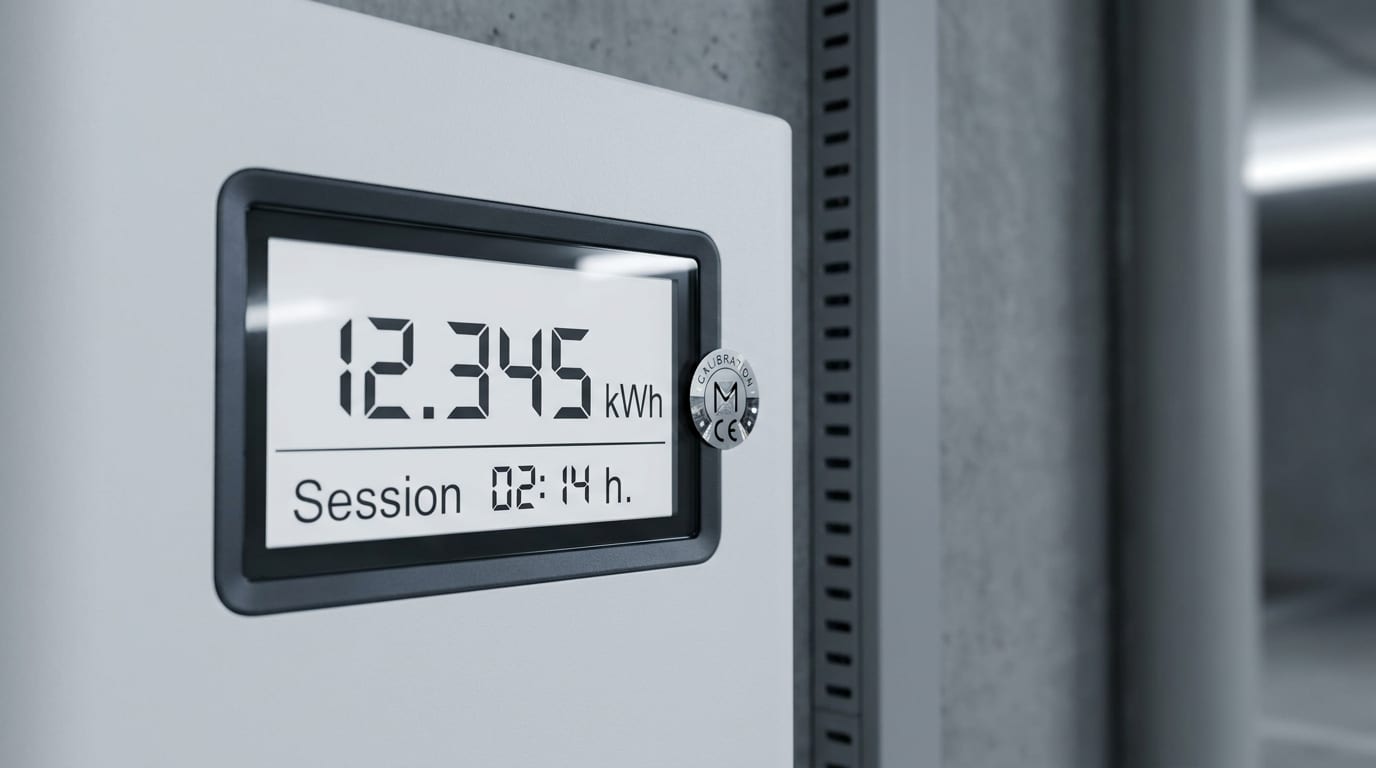
Eichrecht-Compliant Wallbox for Company Cars — MID Isn't Enough
Why MID certification alone doesn't cover company-car billing: Eichrecht explained, PTB requirements, signed measurement data — what employers must verify.
Calibration-Law-Compliant Wallbox 2026 — Rules & Models
Calibration-law-compliant wallbox in Germany 2026: when it's mandatory, how it differs from MID-only wallboxes, which models qualify, and what to check before buying.
Ready for charging infrastructure in your building?
Schedule a free consultation — we'll advise you on the best options for your property.
Book a consultation